How do I clean a bronze plaque? Wording, materials and care
A practical, compassionate guide to cleaning a bronze plaque safely, choosing wording, understanding materials and linking physical memorials with online remembrance.

To clean a bronze plaque, first check the cemetery or memorial-site rules, remove loose debris with water and a soft cloth, then use only the gentlest method needed; do not polish away the patina, use bleach, wire brushes, acidic products or pressure washing. This article also covers wording, materials and care because the safest cleaning choice depends on whether the bronze plaque sits alone, forms part of a headstone, carries a QR code, or includes an inscription that must remain readable.
Bronze is a traditional memorial material because it can hold fine lettering, warm colour and dignified ageing. It is also a copper alloy, so its surface changes over time. A brown, olive or darker patina is not automatically dirt. In many memorial settings, patina is part of the plaque's character and may protect the metal beneath. The mistake families often make is treating every darkened area as something to scrub away. Conservation guidance from the National Park Service on cleaning grave markers is clear about using the gentlest effective method and avoiding harsh tools; that principle applies even when the visible surface is bronze rather than stone.
What to check before you clean a bronze plaque
Before anyone brings a cleaner to the cemetery, confirm who owns or controls the plaque and what permission is required. In Australia, the United Kingdom and the United States, cemetery rules are local: a council cemetery, churchyard, private memorial park, veterans' cemetery and crematorium garden may each have different approval processes. A family may own the right to use a grave without having unlimited freedom to alter, clean, attach, recoat or replace the memorial. If the plaque is loose, cracked, lifting from its base, part of a heritage grave, or attached to a stone that is flaking, stop and ask the cemetery office or a qualified conservator before touching it.
Australia has additional practical layers because each state and territory regulates funerals, burials and cemetery operations differently. The ACCC funeral services guidance is useful consumer context because it reminds families to ask clearly what is legally required and what is simply a provider's process. In the UK, a memorial may sit under a council cemetery's rules, a churchyard faculty process, or a crematorium's memorial-garden conditions; GOV.UK funeral arrangement guidance also separates funeral director costs from cemetery and local authority charges. In the United States, the FTC Funeral Rule gives families rights around funeral goods and services, but cemetery installation and memorial maintenance rules still vary locally.
If the plaque is associated with military service, pause before making assumptions. The U.S. Department of Veterans Affairs has specific rules for VA headstone and marker inscriptions, including approved inscription items and emblems. The VA also explains official headstones, markers and medallions, including bronze markers and medallions for eligible veterans. In Australia, the Department of Veterans' Affairs describes official commemoration as a formal system of names, plaques, headstones and inscriptions, and its principles of official commemoration show why family-led changes should not be improvised. For Commonwealth war graves, the CWGC commemoration policy records how headstone layout, inscriptions and identification are standardised.
Safe cleaning: the practical method
Use this sequence when the plaque is stable, permission is clear, and the surface is ordinary soil, dust, water spotting or light organic residue. First, photograph the plaque before cleaning so the family has a record of its condition. Remove loose leaves, grass and soil by hand or with a very soft natural or nylon brush. Wet the plaque with clean water rather than starting dry, because dry grit dragged across bronze can scratch the surface. Wipe gently with a damp microfibre cloth or soft sponge. If plain water is not enough, use a small amount of pH-neutral, non-ionic soap in water, test a discreet edge, and rinse thoroughly with clean water. Pat dry with a soft cloth so minerals do not settle as spots.
Do not use steel wool, wire brushes, abrasive pads, scouring powder, vinegar, lemon juice, ammonia, bleach, mould remover, oven cleaner, strong acids, strong alkalis or household metal polish. Do not pressure wash a plaque fixed to stone, because water force can drive moisture behind the plate or into joints. Do not sand the raised lettering to make it shine. Brightening the high points may look satisfying for a moment, but repeated abrasion thins detail, changes the intended finish and can make the memorial look patchy. The National Park Service best-practice recommendations for headstone cleaning emphasise long-term effects, not just immediate appearance.
Professional bronze conservation is different from ordinary family maintenance. The Getty Conservation Institute's outdoor bronze coatings research shows that waxes and coatings are technical choices, not generic aftercare products. Outdoor bronze sculptures and plaques may be waxed or coated by specialists to manage weathering, but the wrong product can trap residues, darken unevenly, collect dust or complicate later treatment. The Canadian Conservation Institute's advice on caring for outdoor objects also treats moisture, inspection and regular maintenance as preventive conservation rather than cosmetic polishing.
When not to clean
Do not clean a bronze plaque when the metal is flaking, powdery, pitted, actively corroding, lifting from the backing stone, or carrying paint, enamel, gilding, ceramic inlay or a QR code layer that might be damaged. Do not clean during freezing weather or when hard frost is expected, because water can move into joints and expand. Avoid cleaning during extreme heat as well, particularly if the plaque has coatings or wax that may soften. If the plaque is historic, artist-made, culturally significant or part of a public memorial, seek professional conservation advice rather than treating it as a household item.
Families often ask whether a bronze plaque should be restored to a bright gold tone. Usually, no. New bronze can look warm and luminous, but cemetery bronze is expected to age. The right aim is legibility, respect and stability, not a factory-new shine. Clean enough to remove damaging deposits and allow the name, dates and inscription to be read. Leave stable patina alone. If a family wants a more dramatic restoration, that should be discussed with the cemetery, memorial mason and a conservator because it may involve repatination, coating or replacement rather than cleaning.
Wording, layout and why cleaning cannot fix a poor inscription
The supplied competitor articles focus heavily on headstone wording, and that topic matters here because cleaning only preserves what was designed well in the first place. A bronze plaque usually has less room than an upright stone, so concise wording is stronger and easier to maintain. The usual structure is full name, dates, a relationship line, and one short inscription. A small plaque may only have space for a name, years and a phrase such as remembered with love, devoted father and friend, or always in our hearts. Longer wording can be meaningful, but it may become cramped, collect grime in fine grooves, and become harder to read as the plaque ages.
Families choosing words should think about tone before examples. Is the plaque formal, faith-based, military, cultural, secular, affectionate, or quietly personal? A phrase that suits a large granite headstone may not suit a small bronze plaque. If the family needs a fuller tribute beyond the fixed inscription, Evaheld Memorials' article on memorial tribute writing can help separate the permanent words from the longer story. That distinction protects the plaque from becoming overloaded while still giving the person's life room to be remembered.
Proofreading is not a courtesy step; it is part of care. Check spelling, middle names, accents, nicknames, birth and death dates, religious wording, military rank, punctuation and family order. Ask at least two people to review the proof. If there is family disagreement, choose simpler wording until consensus is clear. Bronze can sometimes be altered, but correction is expensive, visible and not always possible without recasting or replacing the plaque. A clean inscription starts with accurate wording.
Materials: bronze, stone, ceramic, stainless steel and QR plaques
Bronze is durable, but it is not the only memorial material. Granite is common for headstones because it resists weather and holds polished contrast. Marble and limestone can be beautiful but require careful treatment because they are more vulnerable to acids and aggressive cleaning. Ceramic plaques can hold detailed images and crisp colour in protected settings. Stainless steel is often chosen for QR plaques because it can resist corrosion and maintain sharp engraved contrast. Evaheld Memorials compares which plaque materials cope best outdoors for families deciding between stainless steel, ceramic, anodised aluminium, acrylic and other finishes.
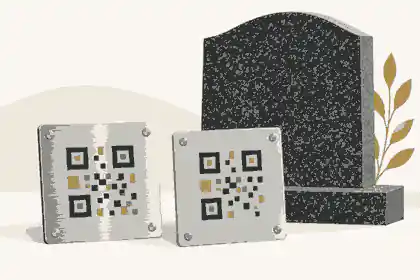
If a bronze plaque includes a QR code, care has an added requirement: the code must remain scannable. The original QR Code was developed for fast two-dimensional reading, and DENSO WAVE's history of the QR Code explains the distinctive position patterns that help scanners recognise it. In practical memorial use, the code still needs contrast, clean edges and quiet space. GS1's 2D barcode colour and quality guide is not written for cemeteries, but its warnings about contrast, quiet zones and reflective surfaces are directly relevant. A glossy bronze surface, decorative border or low-contrast engraving can make a code difficult to scan even if the plaque itself is attractive.
Placement matters as much as material. A plaque under irrigation overspray, mowing debris, falling sap or constant foot traffic will need more maintenance than one set into a sheltered wall. If a QR code is part of the design, Evaheld Memorials explains where to place a QR code on a headstone so visitors can scan without crouching, glare or awkward angles. Families should also ask how long the physical plaque and the linked page are expected to last; the planning article on how long QR memorials usually last is useful because it separates the durable object from the digital destination.
Care routine by setting
For an exposed cemetery plaque, inspect it a few times a year rather than cleaning constantly. Look for soil splash, grass clippings, bird droppings, sprinkler marks, leaf staining, corrosion, lifting adhesive, loose screws and water trapped at edges. Remove organic material promptly because moisture and acids can mark the surface. For a plaque on granite, avoid letting cleaners run onto the stone unless they are safe for both materials. For a columbarium or memorial wall, dust and fingerprints may be the main issue, so plain water and a soft cloth are usually enough. For a garden plaque, reduce mud splash by improving drainage or edging rather than repeatedly scrubbing the plaque.
Seasonal conditions should shape timing. In coastal areas, salt carried by wind can leave a film that deserves gentle rinsing before it concentrates around lettering. In dry inland conditions, dust can behave like an abrasive if rubbed without wetting. In shaded churchyards or lawn cemeteries, algae and lichen around the plaque may indicate moisture problems nearby, but the answer is not stronger chemical cleaning. It is better to improve drainage, trim overhanging vegetation where permitted, and clean the bronze only as much as needed for legibility.
When a plaque is damaged, repair decisions should be practical rather than emotional. A small amount of patina is normal; a cracked plate, unreadable inscription, missing screw, failed adhesive or broken QR code may need professional attention. Evaheld Memorials' guidance on replacing damaged QR memorial plaques is especially relevant when the family wants the same digital memorial to remain connected after a physical replacement. For non-QR bronze, ask whether the original foundry, cemetery supplier or memorial mason has records of the plaque size, font and fixing method.
Do not assume that more frequent cleaning shows more care. Good care is restrained. Keep grass away, remove deposits gently, avoid product build-up and record changes over time. If several relatives visit, agree on one care method so one person is not polishing while another is trying to preserve patina. A short family note can prevent damage: water only, soft cloth only, no polish unless the cemetery or conservator approves.
Connecting a fixed plaque with a living memorial
A bronze plaque is intentionally brief. It marks a place, a name and a memory, but it cannot hold every story, photograph or message. That is why many families pair physical plaques with a digital memorial. The physical marker remains dignified and concise; the online space can hold the wider life story, tributes, images and updates. Evaheld Memorials' article on what to include in a memorial page helps families decide which details belong online rather than forcing them onto metal.
This distinction is visible in public memorial examples. The Evaheld Memorials profile for Tony Bennett shows how a public life can be remembered through music, service, images and narrative chapters rather than one inscription alone. The profile for Barbara Walters demonstrates how a career of interviews, milestones and influence needs more space than a plaque could ever offer. The profile for Alex Trebek shows the same principle for a broadcaster remembered across Canada and the United States: a short marker can honour the person, while a digital memorial can carry context.
If the family wants a QR-enabled memorial, think carefully about what the code should open. Evaheld Memorials explains the kinds of content a memorial QR code can open, including photographs, stories, condolences and service details. Privacy should be decided before sharing. If relatives need time, the FAQ on keeping a memorial private until you are ready to share is relevant. If several people hold stories and photographs, the FAQ on inviting family and friends to help build the memorial explains how collaboration can be handled with clearer stewardship. Families comparing physical plaque options should also check which plan includes QR memorial plaques before ordering separately.
Jurisdictional differences still matter online. Australian families may be coordinating with Services Australia, state registries and cemetery authorities; Services Australia death-of-a-loved-one guidance is a practical starting point for government notifications. UK families may be dealing with local authority cemetery fees and funeral arrangements. U.S. families may be handling benefits, death certificates and agency notifications, and USAGov death-of-a-loved-one guidance gathers those steps in one place. None of those sources decides what a bronze plaque should say, but they show why families often need a memorial workflow that can be edited as administrative details settle.
The best result is usually modest and steady: a clean bronze plaque with legible wording, materials suited to the site, and a care routine that does not erase age. Use the plaque for the permanent essentials. Use the memorial page for the fuller life. If you are ready to connect the physical marker with a private or shareable tribute, Evaheld Memorials can help you clean a bronze plaque as part of a calmer wider memorial plan.


FAQs
How do I clean a bronze plaque? Wording, materials and care
Clean gently with water, a soft cloth and, only if needed, a little pH-neutral soap; avoid polish, bleach, wire brushes and pressure washing. If the plaque is part of a QR or headstone setup, review which plaque materials cope best outdoors and follow the National Park Service cleaning guidance principle of doing the least harm.
Should I polish a bronze memorial plaque until it shines?
Usually no; stable patina is part of bronze ageing and repeated polishing can remove surface detail. If the plaque is weathered but stable, pair restrained care with memorial tribute writing online, while the Getty Conservation Institute shows why coatings and waxes belong in specialist hands.
What should I avoid when cleaning a bronze plaque on a headstone?
Avoid acids, bleach, household metal polish, abrasive pads, wire brushes, pressure washing and any cleaner that may run into stone joints. For placement and access planning, where to place a QR code on a headstone is useful, and the NPS best-practice recommendations explain why long-term effects matter.
How often should a bronze cemetery plaque be cleaned?
Clean only when soil, droppings, sap or staining are affecting legibility or likely to cause damage; inspection is better than routine scrubbing. If the plaque includes a digital element, how long QR memorials usually last helps separate physical care from the linked page, while the Canadian Conservation Institute emphasises moisture and regular inspection outdoors.
Can I clean a bronze plaque with a QR code?
Yes, but be extra careful because the code needs crisp contrast and clean edges to scan. Check the kinds of content a memorial QR code can open, and use the GS1 2D barcode colour guidance as a reminder to protect quiet zones, contrast and readability.
What wording should go on a small bronze plaque?
Use the person's name, dates, relationship if appropriate, and one short line that will still feel right years later. If the story needs more room, what to include in a memorial page helps move longer memories online, while the VA inscription rules show how formal markers often keep wording controlled.
What if the plaque is a veterans' plaque or official marker?
Ask the cemetery or responsible authority before cleaning, altering, repainting or replacing it, because official memorials may have specific rules. Families comparing physical and digital remembrance can also check which plan includes QR memorial plaques, while the VA marker and medallion information explains formal U.S. options.
Can I replace a damaged bronze plaque?
Often yes, but check cemetery permission, the original fixing method, inscription proof and whether a QR link needs to be preserved. Evaheld Memorials explains replacing damaged QR memorial plaques, and the ACCC funeral services guidance is useful consumer context when comparing provider claims and costs.
Can family members help decide wording and care?
Yes, and shared input can prevent errors, but one person should keep the final proof and care instructions organised. Evaheld Memorials supports inviting family and friends to help build the memorial, while Services Australia shows how many practical tasks may be happening at the same time after a death.
Should the memorial stay private while the plaque wording is being finalised?
That is often wise, especially if relatives are still checking dates, spelling, service details or photos. The FAQ on keeping a memorial private until you are ready to share supports a slower process, and USAGov shows why U.S. families may also be managing certificates, benefits and agency notifications.