What are human memorial quotes? Wording, structure and examples
A practical guide to human memorial quotes for obituaries, eulogies, plaques, headstones and online tributes, with examples, structure, privacy and next steps.
What are human memorial quotes? Wording, structure and examples are the short, human words families use to honor a person in an obituary, eulogy, condolence message, online tribute, headstone inscription, plaque, funeral program, QR memorial or shared remembrance page. The best human memorial quotes sound truthful rather than polished: they name the person, hold one clear feeling, fit the space, and leave room for family, friends and future visitors to recognize the life behind the words.
Human memorial quotes are not only decorative lines. They help people decide what should be said publicly, what should stay private, and how a life can be described without reducing it to a phrase. A quote for a stone may need to be fewer than ten words. A quote for an obituary may introduce a longer life story. A quote inside eulogies may become the line everyone remembers from the service. A quote on an online memorial can sit beside photographs, videos, condolences and tributes, so it does not need to carry the whole story alone.
Use this practical structure first: person, relationship or quality, then lasting meaning. For example: Loved mother, steady friend, and the heart of every room. Another structure is memory, value, continuation: Your kindness taught us how to live, and your stories still guide us. These are examples, not scripts. The right wording should feel like something the family could say aloud without embarrassment.
Human memorial quotes: what they are and where they belong
A human memorial quote is a deliberately chosen sentence, line or phrase that helps other people understand what mattered about someone. It may appear in an obituary, a eulogy, a printed order of service, a sympathy card, a funeral livestream description, a headstone, a cremation urn, a memorial bench, a memorial plaque, a social announcement or a digital tribute. It may be formal, conversational, religious, secular, poetic, plain, humorous if appropriate, or deeply personal.
The first decision is not the exact wording. It is the use. A line for a permanent marker has to age well, fit the available space and comply with cemetery rules. A line for a eulogy can be warmer and more detailed because the speaker can explain it. A line for an obituary should respect public facts and family consent. A line for an online tribute can be revised, expanded and supported by photographs and memories over time.
This is why families often begin with memorial tribute writing support before choosing a final quote. A tribute lets you gather facts, feelings and small details first. Then the quote can come from the truth of the person, not from a generic list.
For public funeral choices in the United States, the FTC consumer guidance on funeral services is useful because it reminds families to ask for clear information before agreeing to goods or services. If the quote will be engraved, printed or attached to a paid memorial item, treat wording as part of a practical purchase as well as an emotional decision.
Start with the memorial format, not with the quote list
Competitor pages often begin with long lists of short inscriptions. Lists can help, but they can also make every life sound the same. A better method is to choose the format first, then the emotional job the quote needs to do.
For an obituary, the quote may introduce the life story: A generous teacher, devoted sister and quiet force for good. For a eulogy, the quote may work as a repeated thread: She made ordinary days feel cared for. For a headstone, it may need to become more compact: Loved deeply, remembered always. For a QR memorial or online page, the quote can invite people into a fuller story: Scan, remember, and add the stories that made him himself.
If the quote will sit beside a full obituary, do not make it do too much. A shorter quote can create emotional focus while the obituary handles dates, family relationships, work, service, achievements and funeral details. For families shaping longer obituary wording, life story obituary examples can help turn facts into a warmer narrative.
In the United Kingdom, registering the death and arranging documents may sit alongside funeral writing, so the GOV.UK death registration guidance is a practical reminder that memorial wording is only one part of a wider sequence. In the United States, USAGov guidance after a death points families toward death certificates, government notifications and survivor benefits. In Australia, families should also keep proof of purchase for funeral and memorial services; the ACCC guidance on receipts and proof of purchase explains why written records matter when buying services.
A simple wording structure that works
Most strong memorial quotes follow one of six structures. The first is relationship plus feeling: Beloved father, missed beyond words. The second is character plus impact: Her steadiness gave everyone courage. The third is memory plus continuation: Your stories still sit at our table. The fourth is gratitude plus legacy: Thank you for the love you taught us. The fifth is faith or belief plus comfort: Held in grace, remembered in love. The sixth is place plus belonging: Forever part of this home, this family, this story.
For a short quote, choose one structure and stop. Mixing too many ideas makes the wording weaker. A headstone does not need to say beloved mother, grandmother, friend, gardener, volunteer, baker, traveler and neighbor if one phrase such as The heart of our family says the deeper truth. For a eulogy, however, those details may belong in the body of the speech, where they can be given context. Families who need speech structure can use writing a eulogy with examples to place the quote inside a fuller beginning, middle and closing.
Read every candidate aloud. If the sentence sounds like advertising, a greeting card or a line no one in the family would naturally say, revise it. The quote should not perform grief. It should hold it.
Examples by use
For an obituary opening, try: Maria Chen lived with gentle discipline, generous humor and a gift for making people feel expected. For a eulogy refrain, try: He did not make a show of love; he made a practice of it. For a printed funeral program, try: We remember a life of kindness, courage and ordinary devotion. For a memorial plaque, try: In this garden, we remember the peace she gave us. For a headstone, try: Loved deeply. Remembered clearly. For a QR memorial, try: A life told in stories, photographs and shared memories.
For a parent, a quote may focus on steadiness: You were our first home and our lifelong shelter. For a spouse or partner, it may focus on companionship: My favorite place was beside you. For a child, keep language tender and restrained: Small life, endless love. For a friend, avoid reducing the relationship: Chosen family, trusted heart, unforgettable friend. For someone known publicly through work or service, try: A life of skill, service and quiet generosity.
These examples are deliberately original. They avoid copying familiar competitor phrases while covering the same practical need: short, meaningful wording for plaques, headstones, obituaries, eulogies and tributes.
When deciding what else should surround the quote, what to include in a memorial page is useful because it separates the quote from the wider memorial content: the life story, photographs, service details, guest messages and family updates.
How to make a quote sound personal without making it too private
The fastest way to make a quote human is to add one true detail. The detail might be a role, a phrase, a value, a place, a habit or a relationship. She never let anyone leave hungry is stronger than She was loved by all. His workshop was where problems became stories is stronger than He was a good man. She carried music into every hard day is stronger than She had a beautiful soul.
But not every true detail should be public. Avoid medical information, unresolved family conflict, private addresses, financial details, disputed claims and intimate stories that would surprise or distress close relatives. Privacy matters even after death because memorial pages often include living people. In Australia, the OAIC explanation of personal information is a useful baseline for thinking about information that identifies living people. In the United Kingdom, the ICO data protection principles offer a practical lens: use information fairly, keep it relevant and avoid unnecessary exposure.
If the memorial will be public, compare private versus public online memorials before sharing sensitive wording. A quote can be warm without naming every detail. It can honor a person without exposing relatives.
Headstone, plaque and cemetery wording considerations
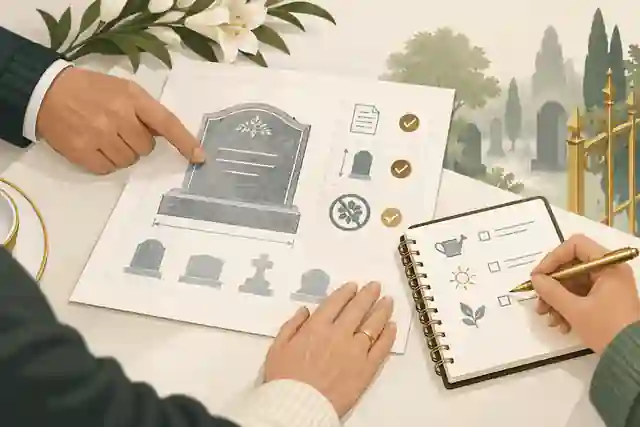
Headstone and plaque wording has three limits: space, rules and readability. Space affects line length. Rules may affect symbols, attachments, language, religious text, QR plaques and installation methods. Readability affects type size, contrast, spacing and how the words will look after years of weathering.
Before approving wording, ask the cemetery, crematorium, churchyard, memorial park or stonemason these questions: How many characters fit? Do spaces count? Are nicknames allowed? Are symbols allowed? Can a QR plaque be attached? Are there rules for wording on shared plots? Can wording be changed later? Do you provide a final proof? How are errors corrected?
Families planning a QR-linked memorial should check cemetery rules for QR codes before ordering a plaque or marker. In the United States, the Department of Veterans Affairs explains official veterans headstones and markers, which have their own application process and limits. In England, funeral and burial choices may also be affected by local cemetery or churchyard practice; GOV.UK guidance on what to do after a death helps families place those choices within the wider administrative process.
For environmental and site management context in burial settings, the United Kingdom also publishes guidance on cemetery and burial groundwater risk, but families should rely on the specific cemetery authority for inscription and placement approval. Local written approval is stronger than assumptions based on examples seen elsewhere.
Religious, spiritual, secular and cultural wording
Religious memorial quotes should reflect the person and the family, not simply the most common phrase. If scripture, a hymn or a prayer mattered to the person, a short line can be deeply appropriate. If the person was secular, a non-religious line is usually more respectful. If family members differ, choose words that name love, gratitude, courage, humor, service or belonging without forcing belief.
In multicultural families across Australia, the United Kingdom and the United States, wording may need to honor more than one language, tradition or naming convention. Ask whether the person used a birth name, married name, chosen name, honorific, cultural title or nickname. A quote can include bilingual wording if the cemetery, printer or platform supports the characters correctly. Always check spelling with someone who knows the language rather than relying on automatic translation.
If using a poem, song lyric, prayer, published line or modern quotation, do not assume it is free to reproduce. Short quotation use varies by country, context and copyright status. In the United States, the U.S. Copyright Office fair use information explains that fair use is a legal doctrine assessed by factors, not a blanket permission. For a permanent plaque, printed program or public website, original wording or clearly licensed text is often safer.
Using online memorials to hold more than one quote
A physical marker usually carries one line. An online memorial can hold many voices. One family member may choose the main quote. Others may leave tributes, memories and condolences that reveal the fuller person over time. This reduces pressure on the first line because the quote is no longer the only memorial text.
That distinction matters when comparing online memorials versus obituaries and tribute pages. An obituary announces and summarizes. A tribute page may gather messages. An online memorial can become a continuing place for story, media, updates and remembrance. If a QR plaque is being considered, what a QR memorial is in practice explains how a physical code can open the digital story behind a brief inscription.
For example, the memorial page for Maya Angelou shows how a remembered public voice can be framed through biography, quotation and story. Leonard Cohen is a useful example of a life where one line can carry poetry, faith and music without attempting to summarize every work. Steve Jobs shows how a concise phrase can sit beside a broader account of invention, design and family memory.
Common mistakes to avoid
Do not choose a quote only because it ranks well or appears often. Common lines may be comforting, but they can become empty if they do not fit the person. Do not use a quote that contradicts the person’s beliefs. Do not make the wording so long that it becomes unreadable. Do not publish private details because grief has made everything feel urgent. Do not let one family member finalize permanent wording before the closest decision-makers have reviewed it.
Do not over-edit the human voice out of the line. A slightly plain sentence that sounds true is usually better than a polished phrase that sounds borrowed. Do not use humor unless it was central to the person and the immediate family agrees. Do not put a living person’s private grief on display without consent. Do not assume a headstone, plaque, urn, printed card and online memorial all need the same quote. Repeating one family line can be beautiful, but different formats may need different wording.
Finally, do not treat grief concentration as a failure. The NHS grief and bereavement guidance notes that grief can affect people in many ways, and the CDC stress guidance describes how stress can affect concentration, sleep, appetite and decision-making. If wording feels impossible, draft three rough lines, pause, and return later.
A practical review checklist before publishing or engraving
Before using a memorial quote, check these points. Is the name spelled correctly? Are dates correct? Is the relationship wording accurate? Does the quote still feel respectful if read ten years from now? Does it fit the space? Has the cemetery, printer or platform approved the format? Does it avoid sensitive personal information? Has the closest family had a chance to review it? If it uses a published quote, is permission or lawful use clear? If it appears online, have privacy settings been chosen first?
For public pages, decide whether guests can add messages and whether comments need approval. The Evaheld Memorials answer on how tributes and condolences can be received on a memorial is relevant when the quote is only the beginning of a shared memory space. If you are still gathering the basics, what information you need before starting a memorial can help organize names, dates, photos, relationships and early wording without forcing a finished tribute immediately.
For cost and consumer decisions, the FTC Funeral Rule guidance for providers is a strong reminder that funeral goods and services should be described accurately, with itemized price information in the United States. In England, Citizens Advice on arranging a funeral gives practical consumer context for planning and paying. These sources do not write the quote for you, but they help protect the surrounding decision.
Choosing final wording
If you are choosing from several versions, print them on paper. Read them aloud. Ask whether each line names the person, the relationship, the quality or the legacy clearly. Remove any word that exists only to sound grand. Replace vague praise with one precise truth. Let the final quote be shorter than your grief, because no line can hold the whole love.
A strong final quote usually passes four tests: it is accurate, kind, readable and durable. Accurate means it does not exaggerate or conceal in a way that feels false. Kind means it protects both the person remembered and the living people connected to them. Readable means it works in its format. Durable means it can be returned to over years without sounding rushed or fashionable.
When your family is ready to preserve the wording with stories, photographs and shared contributions, Evaheld Memorials can help you shape human memorial quotes into a fuller remembrance space that can grow beyond the first line.


FAQs
What are human memorial quotes? Wording, structure and examples
Human memorial quotes are short, truthful phrases used to honor someone in an obituary, eulogy, headstone, plaque, online memorial or tribute. A good structure is name or relationship, one defining quality, and a lasting meaning; memorial tribute writing support can help families shape those details, while the NHS grief and bereavement guidance is a useful reminder to work gently when grief affects concentration.
How do I write a short memorial quote that still feels personal?
Choose one specific truth rather than trying to summarize the whole life: a role, habit, value, relationship or repeated memory. life story obituary examples can help you find that detail, and the U.S. Copyright Office fair use information explains why original wording is often safer than borrowing modern published lines.
What is the best structure for a memorial quote?
The most reliable structure is relationship plus quality plus lasting meaning, such as beloved father, quiet encourager, always part of us. writing a eulogy with examples helps place that line inside a fuller speech, while the CDC stress guidance explains why simple steps can be easier during emotionally heavy decisions.
Can I use the same quote for an obituary, eulogy and headstone?
Yes, if the wording fits each format, but a headstone usually needs the shortest version while a eulogy can explain the meaning behind it. online memorials versus obituaries and tribute pages explains how formats differ, and GOV.UK death registration guidance shows how writing tasks often sit beside formal after-death steps.
What should I avoid putting in a public memorial quote?
Avoid private medical details, conflict, addresses, financial information, disputed claims and anything close relatives have not agreed to publish. private versus public online memorials can help you decide what belongs online, and the OAIC explanation of personal information is useful for thinking about living people named in a memorial.
How many words should a headstone memorial quote have?
There is no universal number, but short lines are usually easier to engrave, read and return to over time. cemetery rules for QR codes also shows why families should ask the cemetery about wording, symbols and attachments, while the veterans headstones and markers page shows that official memorial markers can have specific requirements.
Can a QR memorial hold a longer tribute than the headstone?
Yes. A stone or plaque can carry one short quote while the QR-linked page holds photos, stories, messages, videos and a longer life story. what a QR memorial is in practice explains that link between physical marker and digital story, and GOV.UK guidance on what to do after a death places memorial choices within wider practical steps.
Should a memorial quote be religious or secular?
It should reflect the person and the family’s wishes. Religious wording can be deeply right when it fits; secular wording is often more respectful when belief was private, mixed or absent. what to include in a memorial page helps balance words with other memories, and the ICO data protection principles support a careful approach to relevant, fair information.
Who should approve the final memorial quote?
The closest decision-maker should guide the final wording, but it is wise to ask a small number of trusted relatives to check spelling, tone, dates and privacy before publishing or engraving. what information you need before starting a memorial helps organize those checks, and Citizens Advice on arranging a funeral offers broader practical context.
Can family and friends add their own memorial quotes later?
Yes, on a shared memorial space guests can often add condolences, stories and tribute lines after the first quote is chosen. how tributes and condolences can be received on a memorial explains how this can work, and FTC consumer guidance on funeral services is helpful when memorial choices are part of wider paid funeral planning.