How do I restore a bronze headstone plaque? Wording, materials and care
A practical, authority-led guide to restoring a bronze headstone plaque, covering gentle cleaning, patina, cemetery approval, wording, materials, QR additions and AU/UK/US differences.
To restore a bronze headstone plaque, first confirm the cemetery rules and the plaque’s condition, then clean only with the gentlest suitable method, preserve the patina where it is stable, and use professional conservation for corrosion, failed coatings, repainting or re-patination. The wording, materials and care decisions belong together because a bronze plaque is not just metal: it is a permanent public record, a family tribute, and often part of a regulated cemetery setting.
If you are trying to restore a bronze headstone plaque after years of weathering, the safest starting point is restraint. Bronze is a copper alloy, and outdoor bronze naturally changes colour as it reacts with air, moisture, salts, pollution and handling. Some darkening or green-brown patina may be normal ageing rather than damage. The aim is not to make the plaque look new; it is to make names, dates, symbols and inscription wording legible while protecting the original surface for as long as possible.
Families often search for restoration advice because several concerns arrive at once: the plaque looks dull, the lettering has lost contrast, the cemetery has rules about work on graves, and relatives may also be discussing whether to add updated wording, a small QR plaque, a photo plaque, or a digital remembrance link. A careful plan keeps those decisions in order: permission first, condition assessment second, gentle cleaning third, specialist restoration only where it is genuinely needed, and wording updates only after the family has checked space, layout, material compatibility and cemetery approval.
restore a bronze headstone plaque: practical guidance
Restoration is not the same as routine cleaning. Routine care might remove soil, bird droppings, pollen or plant debris with water, a soft brush and a careful rinse. Restoration goes further: it may involve removing failed lacquer, treating active corrosion, re-darkening a background, polishing raised lettering, applying a protective wax or coating, or replacing a severely damaged plaque. Because those steps can alter the surface permanently, they should be assessed conservatively.
For families who need a narrower maintenance method before considering restoration, Evaheld’s clean a bronze plaque wording materials and care separates gentle care from deeper intervention, which is important when the plaque still has intact lettering, coating or patina.
The US National Park Service advises that cemetery markers should be cleaned with the gentlest means possible and warns against wire brushes, pressure washing, bleach, harsh cleaners and aggressive mechanical methods in its cleaning grave markers guidance. Although that guidance is written for grave markers broadly, the principle applies strongly to bronze plaques: unnecessary force can remove original finish, deepen scratches, leave residues or make future corrosion worse.
For United States families caring for a government-furnished veteran marker, the rules are even more specific. The US Department of Veterans Affairs explains in its cleaning government-furnished headstones and markers guidance that the purpose of cleaning is not to make the marker look like new and that pre-1970s bronze may have a blue-green patina that will not be removed by cleaning. Families should treat that as a warning not to polish away age just because it looks unfamiliar.
In the United Kingdom, historic cemetery and churchyard memorials may need heritage-sensitive handling. Historic England notes that bronze may have an intended surface finish or coating and that assessing condition, cleaning and re-patination are part of the care of some cemetery monuments in its historic cemetery monument care advice. This is especially relevant where the plaque is old, listed, attached to a war memorial, or part of a churchyard with faculty or local authority controls.
In Australia, cemetery trusts and local cemetery operators commonly control whether a memorial can be altered, moved, cleaned professionally or replaced. Victoria’s Department of Health states in its stonemasons and cemetery memorials information that cemetery trust approval is required to establish or alter a memorial or place of interment. Other Australian states and territories have their own cemetery legislation and operator rules, so families should check the specific cemetery before organising work.
Permission comes before polish
Before anyone touches the plaque, identify who owns or controls the grave right, who administers the cemetery, and whether the plaque is privately supplied, cemetery supplied, veteran supplied or part of a public memorial. The person who tends the grave may not be the legal holder of the right of interment. If a mason, conservator or family member works without approval, the cemetery may require the work to be reversed, and accidental damage may become the family’s responsibility.
Because local rules can decide whether cleaning, re-lettering, removal or extra fittings are allowed, Evaheld’s cemetery regulations for headstones wording materials and care is a useful place to prepare the questions before contacting the cemetery office.
Australian war grave plaques need special care. The Office of Australian War Graves explains that it may provide an official bronze plaque depending on the circumstances in its official commemoration information. Its principles of official commemoration also emphasise equality, uniformity and commemoration by name, which means families should not assume an official plaque can be altered like a private memorial.
United Kingdom families may encounter council cemetery rules, churchyard rules, private cemetery rules or war grave arrangements. Bury Council’s cemetery regulations, for example, show how local authorities can regulate inscription, cleaning, repair, safety and work carried out by memorial tradespeople. The exact rulebook differs by council, parish and cemetery, but the practical message is the same: get written approval before changing the plaque or instructing a contractor.
US cemetery rules vary widely between municipal cemeteries, religious cemeteries, private cemeteries, national cemeteries and veterans’ sections. A privately purchased bronze marker may be governed mainly by cemetery rules and the family’s contract. A government-furnished veteran marker has federal ownership and specific cleaning restrictions. When in doubt, ask the cemetery office for the written maintenance policy and ask whether they require approved monument professionals.
How to assess the bronze plaque before cleaning
Begin with observation rather than action. Take clear photographs in daylight from the front, both sides, and close enough to show the lettering, dates, fasteners, edges and any QR code or emblem. Photograph the whole grave too, because water flow, irrigation, grass clipping, tree cover and nearby stone can all affect staining.
Next, decide what problem you are actually trying to solve. Dirt and pollen sit on the surface. Bird droppings may be acidic and should be removed gently. Leaf tannins can stain surrounding stone. White, green or blue-green deposits may be corrosion products or old cleaner residues. Blackening may be stable patina, soot, failed coating or dirt trapped in textured areas. Flaking lacquer or patchy paint in recessed lettering is not a simple cleaning problem; it is a coating problem.
The Pennsylvania Historical and Museum Commission’s cemetery metal types and repairs guidance is a useful reminder that bronze, iron, zinc and other cemetery metals behave differently. Families should not use advice for marble, granite, aluminium, brassware or household copper as if it automatically applied to a cemetery bronze plaque.
If the plaque is loose, cracked, bent, structurally unstable, attached with corroded fasteners, or mounted into damaged stone, stop and ask the cemetery or a qualified memorial mason. Cleaning a loose plaque can worsen damage. If the plaque belongs to a veteran programme, an historic cemetery, or a listed or heritage setting, a conservator may be more appropriate than a general cleaner.
A safe basic cleaning method for family-maintained bronze
For a privately owned, modern bronze headstone plaque in sound condition, the basic family care method is simple. Choose a mild day. Avoid freezing weather, intense heat, direct harsh sun and times when the plaque will dry too quickly. Bring clean water, a soft natural-bristle or nylon brush, cotton cloths, wooden toothpicks for soft debris in grooves, and a small bucket. Do not bring wire wool, metal scrapers, abrasive pads, acidic cleaners, bleach, ammonia, household polish, pressure washers or rotary tools.
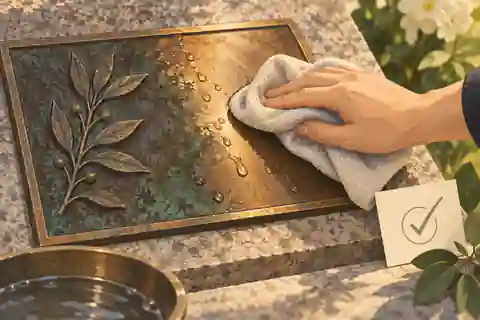
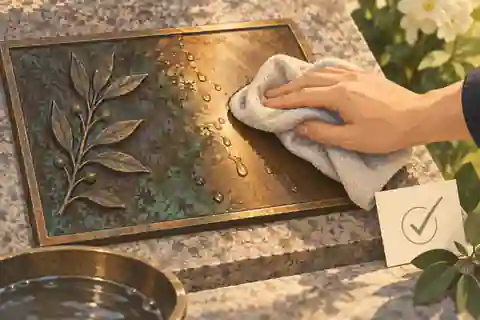
Brush away loose dry debris first. Wet the plaque with clean water. Gently work over the surface with a soft brush, following the detail rather than scrubbing across it. Use a wooden toothpick only for loose deposits in recessed lettering, never to dig into the metal or coating. Rinse thoroughly so no residue remains. Dry with a soft cloth if cemetery rules and weather allow. Then step back. If the plaque is now legible and stable, stop.
The Canadian Conservation Institute explains in its brass and copper cleaning and waxing note that polishing is abrasive and repeated polishing removes surface detail. That matters on a plaque because names, dates, small symbols and raised borders are exactly the details families are trying to preserve.
The broader Canadian Conservation Institute publication on caring for metal objects explains that copper alloys such as bronze can develop a thin stable corrosion layer or patina. A stable patina is often part of the object’s aged surface. Removing it indiscriminately can make the plaque look harsh, expose fresh metal, and create a cycle of more frequent intervention.
When professional bronze restoration is justified
Professional restoration is worth considering when cleaning does not restore legibility, when old coatings have failed, when recessed backgrounds have lost contrast, when the plaque has active powdery corrosion, when fasteners are staining the surrounding stone, or when a family wants a uniform finish for a newer cemetery section. It may also be appropriate where a plaque is part of a formal public memorial and the visual standard must be consistent.
The National Park Service’s National Center for Preservation Technology and Training describes conservation work at national cemeteries that included cleaning, corrosion removal, patination and treatment planning in its national cemetery monument conservation discussion. That kind of work is not ordinary home cleaning. It requires testing, materials knowledge and a decision about whether the existing patina should be preserved, evened out or renewed.
Outdoor bronze preservation can include waxing where appropriate. The National Park Service describes bronze sculpture care at Vicksburg as involving cleaning and hot and cold wax applications in its bronze and metal preservation notes. A cemetery plaque is not the same as a large sculpture, but the principle is relevant: protective coatings should be chosen and applied as part of a conservation plan, not as a quick household shine.
Canadian Conservation Institute advice on outdoor machinery artefacts also warns against continuous polishing of copper alloy fittings because it is destructive and not always historically appropriate. For a headstone plaque, constant bright polishing can make the memorial look newer for a short time while gradually reducing crisp detail.
Wording, layout and inscription choices during restoration
Restoration often prompts wording questions. A family may notice a spelling error, want to add a spouse’s date, update a surname, include a faith phrase, or add a short line that better reflects the person. Bronze plaques are less forgiving than digital memorials because space, moulds, lettering style and cemetery standards constrain what can be changed.
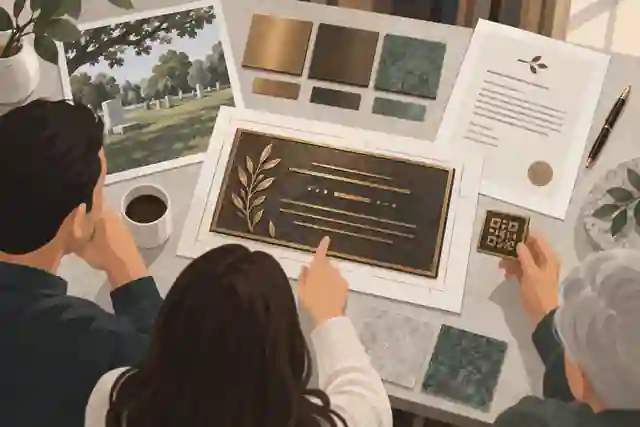
Most plaque wording starts with the person’s name, birth and death dates, and a brief inscription. If there is room, families may include a relationship line, service reference, faith phrase, small emblem, or short quote. The strongest wording is usually specific, calm and brief. If you need separate wording help, Evaheld’s short quotes for headstones wording materials and care can help you keep the line concise enough for a physical marker.
A useful test is whether the wording will still feel true in twenty years. Avoid phrases chosen only because they are common. Consider the person’s actual voice, beliefs and relationships. A bronze headstone plaque is not the place to summarise every achievement; it is a place for the essential record and one enduring thought. Longer stories, memories, photographs and tributes can sit elsewhere, especially where family members disagree about what belongs permanently on the plaque.
If relatives are still deciding between several versions, a shared draft process can reduce pressure. Evaheld’s memorial tribute writing guidance is useful before plaque wording is finalised because it helps families gather true details first, then distil them into shorter wording. That sequence usually produces better inscriptions than starting with a list of stock phrases.
Historic England’s war memorial inscription conservation advice is also valuable beyond war memorials because it frames inscriptions as records that need careful decision-making before intervention. Where lettering is fading, the first question should be whether cleaning, repainting, re-cutting or replacement is necessary at all; the second should be who is qualified to do it.
Materials: bronze, stone, QR plaques and photo plaques
Bronze is durable, dignified and traditional, but it is not maintenance-free. It reacts to water, salts, air pollution, lawn chemicals, irrigation, coastal exposure and handling. It can be cast, etched, engraved, patinated, coated and mounted in several ways. Its appearance also depends on the stone or base around it. A bronze plaque set into granite will age differently from one fixed to a concrete beam, memorial wall, lawn marker or columbarium niche.
If the family is adding a QR plaque or replacing a damaged attachment at the same time, match the new material to the setting rather than simply choosing the shiniest option. Evaheld’s the best materials for QR memorial plaques explains why weather resistance, glare control and scan contrast matter for outdoor plaque materials. That same thinking applies when a bronze memorial includes a small modern addition.
Placement matters too. A QR code or added plaque should not crowd the original inscription, hide a symbol, interfere with mowing, or sit where water pools. Evaheld’s where to place a QR code on a headstone helps families think about visibility, scanning angle and visual restraint before asking the cemetery or mason for approval.
Photo plaques raise similar questions. They can be beautiful, especially for families who want a face beside a name, but they introduce different materials and possible failure points. If you are comparing portrait plaques, bronze plaques and QR-linked tributes, Evaheld’s photo plaques for graves wording materials and care is a practical companion to a bronze restoration conversation.
Care mistakes that cause avoidable damage
The most common mistake is trying to make old bronze bright. A bronze plaque does not need to look like a polished household ornament. Harsh polishing can strip darkened backgrounds, flatten high points, widen scratches and leave residues in lettering. Another mistake is using stone-cleaning advice on metal or metal-polishing advice on stone. Many plaques sit on granite, marble, concrete or sandstone, and a cleaner that affects one material may stain or damage the other.
Pressure washing is a particular risk. It can drive water into seams, lift weak coatings, damage surrounding stone, and remove original surface material. Bleach, acids, vinegar, ammonia, abrasive powders and bathroom cleaners are also poor choices. They may create a short-term visual change while leaving salts, scratches or chemical residues that make future care harder.
Families should also avoid repeated casual cleaning by different relatives using different products. Keep a simple care note: date, method, products used, photographs before and after, and whether the cemetery was contacted. If a professional restores the plaque, keep their report and any warranty or coating information. This record helps future family members avoid accidental over-treatment.
Australia, United Kingdom and United States differences
In Australia, the primary issue is usually cemetery trust or operator approval. State and territory systems differ, and cemetery rules can vary even within one city. Families should ask who may apply to alter a memorial, whether a registered stonemason must do the work, whether the plaque can be removed for workshop restoration, and whether official war grave plaques have separate requirements.
In the United Kingdom, local authority cemeteries, private cemeteries and churchyards may each apply different rules. Church of England churchyards can involve faculty jurisdiction, while council cemeteries usually have memorial regulations and approved mason schemes. Historic or war memorial plaques need particular care, and families should avoid cleaning or re-lettering that changes heritage fabric without permission.
In the United States, families should separate private cemetery rules from veteran marker rules. Private bronze markers are often managed through the cemetery and monument dealer. Government-furnished veteran markers are federal property and have specific maintenance expectations. State and municipal cemetery preservation groups may also give guidance, but the cemetery’s written rules and the marker’s ownership status come first.
How digital remembrance can support a restored plaque
A restored bronze plaque can make the physical memorial readable again, but it cannot hold every story. That is not a weakness. A plaque should do the work it does best: name, dates, identity, a short inscription and a stable place to visit. Longer memories, photographs, voice recordings, service details and family contributions can sit in a digital memorial that can be updated without altering the metal.
Evaheld explains what a QR memorial is in practice for families considering a discreet bridge between a grave marker and a fuller tribute. A QR memorial does not replace the plaque; it can complement it by giving visitors a way to see photographs, stories and messages without crowding the headstone.
If relatives in different places need to help gather photographs, check wording or contribute memories before the plaque is restored, Evaheld’s FAQ on how family and friends can be invited to help build the memorial is relevant. It helps separate collaborative memory gathering from the final physical inscription decision.
Families who want the physical plaque and digital tribute to work together should also confirm the plan level that includes QR plaques. Evaheld’s FAQ on which plan includes QR memorial plaques explains the plaque-linked option, while the family still remains responsible for cemetery approval and local installation requirements.
Public memorial profiles show why a fixed inscription and a fuller life story serve different purposes. A bronze plaque might name a singer and dates, but a memorial profile such as Tony Bennett can hold context about a long creative life. A plaque might record a broadcaster’s name, while Barbara Walters can be remembered through a richer public narrative. A concise inscription could never hold every memory associated with Alex Trebek, which is why physical and digital remembrance work best when each is allowed to do its own job.
A practical restoration checklist
- Photograph the plaque, surrounding stone, fixing points and inscription before any work begins.
- Confirm who has authority over the grave and ask the cemetery for written rules.
- Identify whether the plaque is private, cemetery supplied, veteran supplied, official, historic or part of a public memorial.
- Decide whether the problem is dirt, staining, failed coating, corrosion, loose fixing, poor contrast or wording.
- Use only water, soft brushes and gentle hand cleaning for basic care unless a qualified professional advises otherwise.
- Do not use wire brushes, pressure washers, bleach, acids, ammonia, abrasive polish or rotary tools.
- Preserve stable patina unless there is a clear conservation reason to treat it.
- Use a memorial mason or conservator for re-patination, coating removal, repainting recessed fields, structural repair or removal from the grave.
- Finalise wording only after checking cemetery rules, plaque size, lettering style, date format and family spelling.
- Keep a record of every cleaning, repair, approval and restoration decision for future family members.
The most authoritative answer is often the calmest one: restore only what needs restoring, protect what is original, and let the plaque remain dignified rather than artificially new. When families also want to preserve the stories that cannot fit on bronze, they can restore a bronze headstone plaque as the physical anchor while building a fuller shared memorial around it.
FAQs
How do I restore a bronze headstone plaque? Wording, materials and care
Start by confirming cemetery permission, then assess whether the plaque needs light cleaning, professional conservation, wording repair or replacement. Keep the method gentle, preserve stable patina, and use clean a bronze plaque wording materials and care alongside the National Park Service cleaning guidance before deciding what to do.
Can I polish a bronze cemetery plaque until it shines?
Usually no. Polishing is abrasive and can remove patina, surface detail and lettering contrast, so a shiny finish is not the goal for most cemetery bronze. Evaheld’s the best materials for QR memorial plaques explains outdoor material durability, while the Canadian Conservation Institute brass and copper note explains why repeated polishing can cause loss.
Do I need cemetery permission before restoring a bronze plaque?
Yes, you should ask the cemetery or grave administrator before cleaning beyond light care, altering wording, removing the plaque or hiring a mason. Evaheld’s cemetery regulations for headstones wording materials and care can help you frame the questions, and Victoria’s cemetery memorial guidance shows why approval can be required before memorial alterations.
What wording should go on a restored bronze headstone plaque?
Most restored plaques should keep the wording concise: full name, dates, relationship or service line, and one brief inscription if space and cemetery rules allow. Evaheld’s short quotes for headstones wording materials and care supports that decision, and Historic England’s inscription conservation advice reinforces the need to treat inscriptions as long-term records.
Can a QR code be added when a bronze plaque is restored?
Often yes, but only if cemetery rules allow it and the placement does not crowd the original inscription or reduce readability. Evaheld explains where to place a QR code on a headstone, while the US Veterans Affairs marker cleaning guidance is a useful reminder that official markers may have stricter rules than private plaques.
What is the safest cleaner for a bronze headstone plaque?
For basic family care, clean water, a soft brush and a careful rinse are the safest starting point; anything stronger should be tested and approved for the plaque’s condition. Evaheld’s clean a bronze plaque wording materials and care pairs well with the National Park Service advice to use the gentlest method.
When should a professional restore the plaque?
Use a professional when the plaque is loose, historic, officially supplied, heavily corroded, coated with failing lacquer, structurally damaged or no longer legible after gentle cleaning. Evaheld’s photo plaques for graves wording materials and care can help compare physical memorial options, while the NPS national cemetery conservation discussion shows how specialist treatment can include testing, corrosion removal and patination.
Is green patina on bronze always bad?
No. Some green, brown or dark patina can be a normal part of bronze ageing, while powdery, spreading or uneven corrosion may need expert assessment. Evaheld’s the best materials for QR memorial plaques explains weather exposure, and the Canadian Conservation Institute metal care publication explains patina as a corrosion layer that may be stable.
Can family members help decide plaque wording online?
Yes, it is often wise to gather family memories and wording preferences before approving any permanent inscription change. Evaheld’s how family and friends can be invited to help build the memorial supports shared contribution, while Australian official commemoration principles show why formal plaques may still have limits on wording.
Which Evaheld option includes QR memorial plaques?
The Evaheld Memorials option that includes QR memorial plaques is explained in the plan FAQ, but cemetery permission and installation rules still need to be checked separately. See which plan includes QR memorial plaques and compare it with official Australian bronze plaque commemoration where a veteran or official memorial is involved.