What are the most secure closed-loop family memorial pages? Features, privacy and family fit
A practical Evaheld Memorials article that answers “What are the most secure closed-loop family memorial pages?”, explains the most secure closed-loop family memorial pages, shows what to include, avoids common mistakes and helps families plan features, privacy and family fit.
The most secure closed-loop family memorial pages are private, invitation-based remembrance spaces that let a family control who can view, contribute to and update memories, photos, messages, wishes and practical instructions. In practice, look for ad-free design, clear permission controls, account security features, easy updating, export or preservation options, and a calm experience that does not expose a loved one’s story to the open web unless the family chooses to share it.
Direct answer: What are the most secure closed-loop family memorial pages?
A secure closed-loop family memorial page is not simply an online obituary with a privacy toggle. It is a controlled family space where access is intentional, contributions are manageable, and sensitive material is kept separate from public search, advertising and casual social media sharing. For many families, this means choosing one of the best ad-free secure online memorials rather than relying on scattered group chats, social posts, email threads or folders on different devices.
Security is partly technical and partly practical. Technical basics include strong account protection, private sharing links or invitations, sensible data handling, and a platform that explains how information is stored and managed. Practical security means deciding who should have access, what should remain private, who can approve contributions, and how the page will be maintained over time. The Australian Government’s guidance on multi-factor authentication, the U.S. Cybersecurity and Infrastructure Security Agency’s Secure Our World advice, and the U.S. Federal Trade Commission’s guidance on protecting your privacy online are useful starting points for the habits that support safer memorial sharing.
For a practical option, Evaheld Memorials helps families create, complete, store, update and share private memorial content in one organised place. It is not a substitute for legal, financial, medical or grief-counselling advice, but it can reduce the stress of keeping memories, guestbook contributions, wishes and instructions scattered across many people and platforms.
What the most secure closed-loop family memorial pages is for
The most secure closed-loop family memorial pages are for families who want remembrance to feel personal, protected and organised. They can hold stories, photographs, videos, messages, ceremony details, music choices, personal wishes, family history and a moderated guestbook without requiring everything to be public. This is especially helpful when a family wants to include children, older relatives, friends overseas or community members while still keeping control over visibility.
A closed-loop page can also support digital preservation. The Library of Congress offers practical guidance on personal digital archiving, including the importance of organising files and making considered decisions about long-term access. The U.S. National Archives also provides helpful guidance on preserving family archives. These principles apply beautifully to online memorials: name files clearly, choose what matters most, keep related materials together, and avoid relying on a single person’s phone or inbox.
When comparing affordable online memorial websites, consider whether the page is mainly a public tribute, a digital obituary, a family archive, a ceremony coordination tool, or a longer-term digital legacy vault. Evaheld Memorials is designed as a practical memorial planning layer, helping families keep the tribute, messages and related instructions connected. You can explore how this works through creating a memorial page, reviewing online memorial features, or considering a broader digital legacy vault.
When to use the most secure closed-loop family memorial pages
A closed-loop memorial page is useful before, during or after a funeral, memorial service, anniversary or family gathering. It can be created during end-of-life planning, after a death has occurred, or later when a family is ready to gather memories in a calmer way. There is no single right time; the better question is whether the family needs a safer, more organised place than social media, messaging apps or a shared drive.
It is particularly helpful when privacy matters. Some families do not want a loved one’s details indexed by search engines. Others need to protect children’s identities, home addresses, service locations, family disputes, health details or culturally sensitive information. The Office of the Australian Information Commissioner explains key privacy rights, the eSafety Commissioner offers guidance on online privacy, and the UK Information Commissioner’s Office provides privacy information for the public. These sources are useful reminders that privacy is not just a setting; it is a family decision about dignity, consent and context.
Closed-loop memorials can also help when relatives live in different countries or time zones. A mobile-friendly memorial site lets people contribute when they can, rather than requiring everyone to attend one event. If your family is comparing related formats, you may also find it useful to read about simple virtual guestbooks, best permanent digital obituaries, and online memorial platforms with a one-time fee.
What to include in the most secure closed-loop family memorial pages
The best virtual memorial features are the ones that make the page meaningful without making it overwhelming. A strong closed-loop memorial page usually includes a short life story, selected photographs, video or audio memories, important dates, service or gathering information, family-approved messages, and a way for invited people to contribute. It may also include personal wishes, favourite readings, songs, recipes, cultural traditions, charity preferences, and practical notes for those helping with arrangements.
For privacy, separate public-facing tribute material from sensitive family information. A warm story about a loved one’s garden, humour or favourite music may be suitable for a wider circle. Details about medical history, family conflict, legal documents, financial information, passwords or private addresses usually need far tighter control and may belong in separate professional or secure document systems. Legal requirements vary by country, state and territory, so formal documents should be checked against local rules or reviewed by a qualified professional where needed.
If digital account access is part of your family planning, use official guidance rather than guesswork. Apple provides information about Legacy Contact for Apple ID, and Google explains its Inactive Account Manager. These tools are separate from a memorial page, but they sit alongside the same planning conversation: who should be able to access, preserve or close digital materials, and under what circumstances?
Step-by-step instructions for the most secure closed-loop family memorial pages
- Choose the purpose first. Decide whether the page is for a ceremony, ongoing remembrance, a private family archive, or a combination of these.
- Map your audience. List immediate family, close friends, extended community and any people who should not have access. This helps avoid accidental oversharing.
- Gather core materials. Select photos, dates, stories, video clips, readings and guestbook prompts. Keep originals safely backed up.
- Set permissions carefully. Decide who can view, contribute, edit or approve content. Use the smallest sensible access group at the beginning.
- Protect accounts. Use strong, unique passwords and consider a reputable password manager. The Australian Cyber Security Centre explains how password managers can help reduce risky reuse.
- Review contributions before sharing widely. Check names, dates, images, cultural sensitivities and whether each contributor understood where their message would appear.
- Plan maintenance. Nominate one or two trusted people to update the page, respond to family requests and review access over time.
If you are ready to compare options or begin planning, you can create a secure Evaheld Memorials page for secure closed-loop family memorial pages, then update it over time and share it with trusted people when ready.
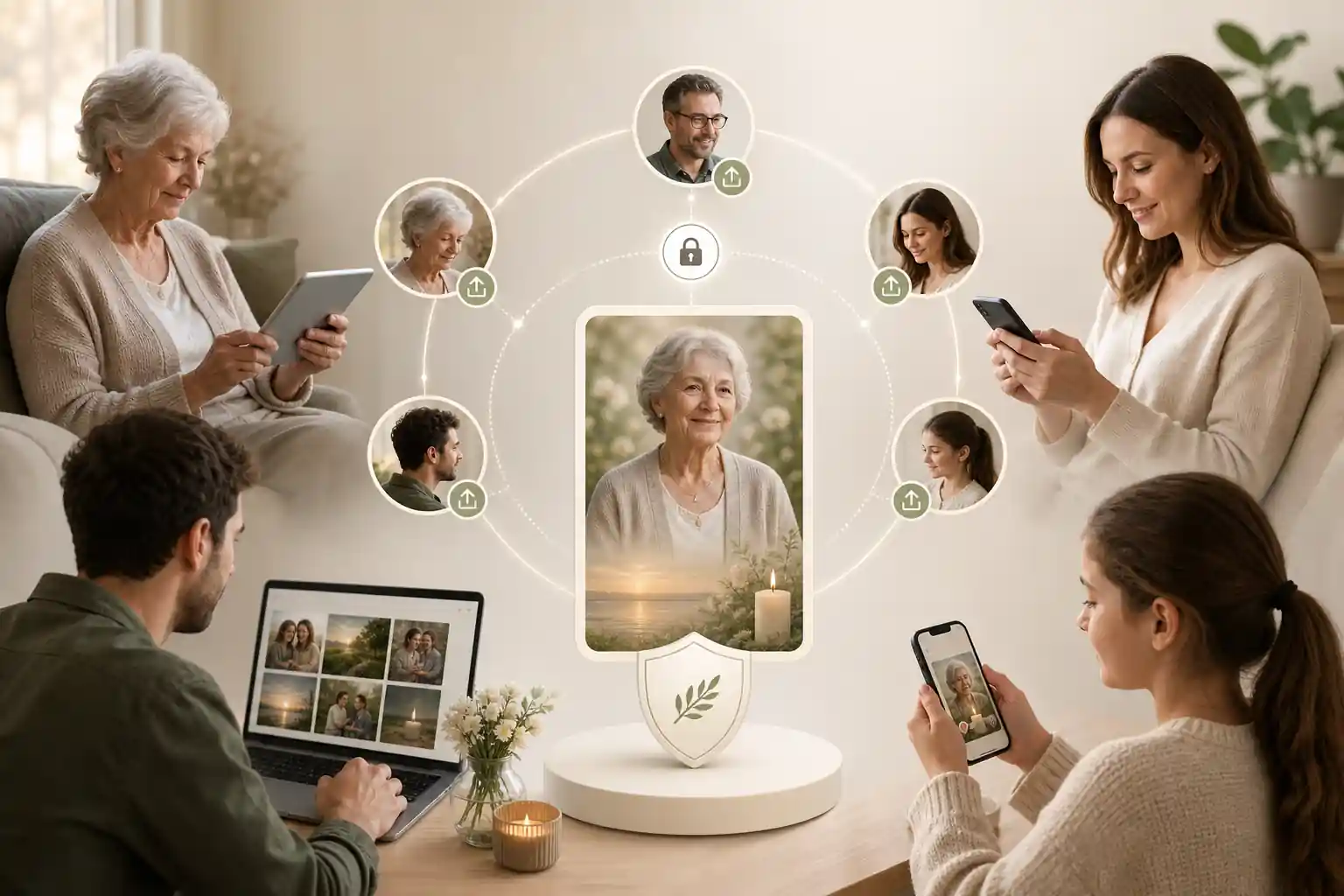
Practical tips for families
Start small. A memorial page does not need to be complete on the first day. Many families begin with a few carefully chosen photos, a short tribute and a simple guestbook prompt, then add richer stories later. This can be gentler than asking everyone to supply perfect memories during the most difficult week.
Use plain language for invitations. Tell people whether the page is private, whether their message may be seen by other invited guests, and who will moderate contributions. This reduces confusion and helps people share with care. If you are using the page alongside a funeral director, celebrant, cemetery authority, lawyer, counsellor or community elder, be clear about which matters belong on the memorial page and which need professional or official handling.
Think about preservation as an ongoing habit. The Digital Preservation Coalition’s digital preservation handbook explains that long-term digital care involves more than saving files once. Formats, accounts, access and family needs can change. A useful memorial page should therefore be easy to revisit, refine and share with the right people over time.
Common mistakes
- Making everything public by default. Public pages can be appropriate, but they are not the same as closed-loop family memorial pages.
- Using one shared login. Shared credentials make it harder to manage accountability and can create security risks.
- Uploading sensitive documents without a plan. Wills, financial records, medical details and identity documents may require separate professional storage or advice.
- Forgetting mobile users. Top mobile friendly memorial sites are easier for older relatives, travellers and overseas family members to use.
- Letting the page become cluttered. Too many uncurated files can make a memorial harder to read and preserve.
- Not discussing consent. Ask before sharing images of children, private family moments, culturally sensitive ceremonies or other people’s personal stories.
Another common mistake is ignoring scams. Memorial pages may be created during emotionally vulnerable moments, and families can be targeted through fake links, donation requests or impersonation. The FTC’s advice on recognising and avoiding phishing scams is a useful reminder to slow down before clicking links, sharing payment details or responding to urgent messages.
What not to do
Do not treat a memorial page as a replacement for formal estate planning, probate processes, powers of attorney, funeral contracts, cemetery approvals, tax advice or official identity management. It can help organise wishes, memories and instructions, but jurisdiction-sensitive documents should be handled according to local requirements. The Uniform Law Commission’s materials on fiduciary access to digital assets show how complex digital access can be in legal contexts, especially across jurisdictions.
Do not post passwords, security questions, banking information or identity documents in a tribute area. Do not invite a large audience before checking the page settings. Do not assume that a social media memorial, public obituary and private family archive all serve the same purpose. And do not pressure grieving relatives to contribute before they are ready; a closed-loop page should make participation easier, not obligatory.
How Evaheld Memorials helps create, complete, store, update and share the most secure closed-loop family memorial pages
Evaheld Memorials helps families bring scattered remembrance materials into one calmer, more organised experience. Instead of keeping stories in text messages, ceremony notes in one person’s email, photographs on several phones and guestbook entries in a paper book, families can create a memorial page, add meaningful content, update it over time and share access with trusted people when appropriate.
The value is not that one platform replaces every professional or personal support. Rather, Evaheld Memorials gives families a practical structure for tribute pages, messages, photos, guestbook inputs, wishes and instructions. This can make an online memorial websites comparison easier because you can assess whether a platform supports your real family needs: privacy, ease of use, updating, ad-free presentation, contribution management and long-term usefulness.
When comparing subscription-free online memorials, online memorial platforms with one time fee, or other affordable online memorial websites, read the details carefully. Consider pricing, storage, access controls, export options, support, mobile usability and whether the memorial can grow with the family. Evaheld Memorials provides information about online memorial plans and answers common memorial support questions so families can make a considered choice without pressure.
Final checklist
- Decide whether the memorial should be private, public, or shared only with invited people.
- Choose an ad-free, user friendly online memorial platform with clear privacy and permission controls.
- Use strong account security, unique passwords and multi-factor authentication where available.
- Separate tribute content from sensitive legal, medical, financial or identity information.
- Gather key photos, stories, dates, ceremony notes, guestbook prompts and family wishes.
- Ask for consent before sharing images, children’s details or private family stories.
- Nominate trusted people to help complete, review and update the page.
- Check all names, dates, links, access settings and contribution permissions before sharing.
- Keep original files backed up and review the memorial over time.
- Seek qualified professional advice for formal documents or jurisdiction-specific requirements.
The most secure closed-loop family memorial pages combine privacy, thoughtful sharing and long-term care. With a clear plan and the right support, a family can create a remembrance space that feels safe, dignified and genuinely useful for the people who loved the person being honoured.
FAQs about the most secure closed-loop family memorial pages
What are the most secure closed-loop family memorial pages?
The most secure closed-loop family memorial pages are private, invitation-based remembrance spaces that let a family control who can view, contribute to and update memories, photos, messages, wishes and practical instructions. In practice, look for ad-free design, clear permission controls, account security features, easy updating, export or preservation options, and a calm experience that does not expose a loved one’s story to the open web unless the family chooses to share it.
The most secure closed-loop family memorial pages are private, permission-based memorial spaces where invited people can view or contribute memories, photos, messages and practical details without making everything public. Evaheld Memorials helps families create secure closed-loop family memorial pages with a calm, organised approach; for broader privacy habits, see the OAIC privacy rights guidance.
How can an online tribute feel personal and respectful?
It is used to keep remembrance content, family tributes, guestbook messages and selected instructions in one controlled place rather than scattered across social media, email and devices. You can review online memorial features through Evaheld Memorials features, and the Library of Congress personal archiving guide is helpful for thinking about long-term digital preservation.
When should a family create or review the memorial?
A family should consider one when privacy matters, when many relatives need a shared place to contribute, or when a public memorial page feels too open. If you are ready to begin, you can create a memorial page with Evaheld Memorials; for online privacy basics, the eSafety Commissioner privacy resources offer practical guidance.
Who should manage the page and approve contributions?
Include a short life story, selected photos, tribute messages, service information if appropriate, family contribution guidance and any non-sensitive wishes you are comfortable sharing. Evaheld Memorials also supports organised digital legacy planning through its digital legacy vault; for family records, the U.S. National Archives family archives guidance is a useful reference.
What content belongs on the memorial page?
Start with the core tribute, choose privacy settings, invite trusted contributors, add photos and messages, review sensitive details, then update the page over time. If you need help comparing options, see online memorial platforms with a one-time fee, and follow safe account habits from CISA Secure Our World.
How can families control privacy and sharing?
Common mistakes include sharing access too widely, uploading private documents without consent, using weak passwords, forgetting to review permissions and relying on only one person to manage updates. Evaheld Memorials answers common planning questions in its memorial support questions, and the FTC online privacy guide explains simple protective steps.
Which account details and backups should be retained?
Avoid posting financial details, identity documents, private family disputes, unverified health information or anything the person or close family would not want shared. For a simpler contribution model, compare simple virtual guestbooks, and review the FTC phishing scam guidance before responding to unexpected messages.
How can relatives contribute safely?
Privacy and permissions usually involve deciding who can view, contribute, edit or manage the page, then reviewing those choices as family circumstances change. Evaheld Memorials explains available options on its online memorial plans page, while the UK Information Commissioner’s Office public guidance gives helpful privacy context.
What common online memorial mistakes should families avoid?
Evaheld Memorials helps families create, complete, store, update and share memorial content in one organised experience, including tributes, photos, messages, guestbook inputs and selected wishes. You can also compare related options such as best permanent digital obituaries; for stronger sign-in protection, see the Australian Cyber Security Centre guidance on multi-factor authentication.
How does Evaheld Memorials support long-term preservation?
Check names, dates, photo permissions, invite lists, privacy settings, contribution rules, sensitive details and who will manage future updates. Before final sharing, you may wish to review Evaheld Memorials online memorial features and the Australian Cyber Security Centre guidance on password managers for safer access management.
If your family is ready to begin, create a free Evaheld Memorials page and add memories, photos and tributes at your own pace.