What are the best platforms for storing life stories? Features, privacy and family fit
A practical Evaheld Memorials article that answers “What are the best platforms for storing life stories?”, explains platforms for storing life stories, shows what to include, avoids common mistakes and helps families plan features, privacy and family fit.
The best platforms for storing life stories are secure, easy to update, simple for family members to contribute to, and clear about privacy, sharing and long-term access. For most families, the strongest choice is a platform that combines photos, stories, audio or video, guestbook messages, wishes and practical instructions in one organised place, rather than scattering memories across phones, social media accounts and cloud folders.
A good life-story platform should feel respectful rather than complicated. It should help you preserve a person’s voice, values, milestones and relationships, while also giving trusted people enough context to understand what matters. Evaheld Memorials is one option for families who want a dedicated memorial planning layer: a place to create, complete, store, update and share tribute pages, memories, messages and related wishes when the time is right.
Direct answer: What are the best platforms for storing life stories?
The best platforms for storing life stories usually have five qualities: clear storytelling tools, strong privacy settings, family contribution options, reliable storage and a design that is simple enough for non-technical relatives. When comparing online memorial websites, look beyond appearance and ask how the platform will work months or years later.
Some families use a dedicated online memorial page, some use private cloud folders, some keep written journals and scanned archives, and some work with a funeral director, celebrant, solicitor or estate-planning professional. These can all be useful. The practical question is whether the chosen system helps people find, understand and respectfully share the life story without confusion.
| Platform type | Best for | Watch-outs |
|---|---|---|
| Dedicated online memorial platforms | Tributes, photos, guestbook messages, family sharing and ongoing remembrance | Check privacy, pricing, export options and who can update the page |
| Cloud storage folders | Archiving documents, large media files and scans | Can become messy without captions, permissions and a clear folder structure |
| Social media memorialisation | Community recognition and informal sharing | Less suited to curated life stories, family instructions or private wishes |
| Printed books or journals | Tangible keepsakes and guided reflection | Harder to update, duplicate or share with distant relatives |
For a broader comparison of digital formats, Evaheld Memorials has related guides to top mobile-friendly memorial sites, subscription-free online memorials and the top virtual tribute pages.
What platforms for storing life stories is for
Platforms for storing life stories are for preserving more than dates and formal records. They help families collect the human details: favourite sayings, childhood memories, photographs, recipes, service stories, cultural traditions, music, letters, achievements, humour, lessons learned and messages for future generations.
They can also support practical organisation. A memorial page or digital legacy space can sit alongside information about preferred readings, music, funeral wishes, charitable causes, contact lists or instructions about where important documents are kept. This does not replace legal, financial or medical advice, but it can make family communication calmer and more coherent.
Archival guidance from the U.S. Library of Congress on personal digital archiving recommends actively selecting, organising and backing up important digital materials. The U.S. National Archives also offers practical advice on preserving family archives, including photographs, papers and personal records. The same principles apply online: choose what matters, label it clearly, and keep it somewhere trusted people can access when appropriate.
When to use platforms for storing life stories
You do not need to wait until a funeral is imminent. Many families begin while a parent, grandparent, partner or friend is still able to share stories in their own words. Others start after a death, using photos, messages and memories contributed by relatives and friends.
Life-story platforms can be helpful during advance planning, after a diagnosis, before a major move, when downsizing a family home, before travel, during estate planning conversations, or when younger family members begin asking about their heritage. They can also be valuable after a funeral, when people remember details gradually and want somewhere respectful to add them.
If your planning touches wills, powers of attorney, probate, health decisions or formal funeral authorisations, requirements vary by country, state and territory. Formal documents should be checked against local rules or reviewed by a qualified professional where needed. Evaheld Memorials can help organise and share wishes and memories, but it is not a substitute for legal, medical, financial or grief-counselling advice.
What to include in platforms for storing life stories
A useful life-story platform balances emotion with structure. Start with the essentials, then add depth over time. You do not need a perfect biography on day one.
- Core biography: full name, preferred name, important dates, places lived, family connections and major life chapters.
- Photos and captions: identify people, places, dates and the story behind the image where possible.
- Personal stories: childhood memories, work, service, travel, community life, faith, culture, hobbies and defining moments.
- Voice and personality: favourite phrases, music, recipes, humour, values, advice and small habits people will miss.
- Messages and tributes: reflections from family and friends, guestbook entries and short remembrance notes.
- Wishes and preferences: funeral or memorial ideas, readings, music, flowers, donations and people to notify.
- Practical context: where key documents may be located and who should be contacted, without exposing sensitive details publicly.
For privacy, avoid uploading unnecessary identity documents, account passwords, full financial information or private medical details to any public page. Australian readers can review privacy rights through the Office of the Australian Information Commissioner, while UK readers may find the Information Commissioner’s Office public guidance helpful. In the United States, the Federal Trade Commission explains how to protect your privacy online.
Step-by-step instructions for platforms for storing life stories
- Choose the purpose. Decide whether the page is mainly for remembrance, funeral sharing, private family history, practical planning or a combination.
- Pick the right platform. Compare privacy, ease of use, mobile experience, family contributions, pricing and long-term update options.
- Create a simple structure. Use sections such as life story, photos, messages, milestones, wishes and guestbook.
- Gather material. Collect photos, recordings, letters, recipes, service records, newspaper clippings and memories from family members.
- Add context. Captions and short notes make archives more meaningful than unnamed files.
- Set permissions. Decide what is public, private or shared only with trusted people.
- Invite contributors. Ask relatives and friends for one story, one photograph or one message to keep the task manageable.
- Review sensitive content. Remove private addresses, account details, family disputes or information others would not expect to be shared.
- Update over time. Add new memories, correct details and refine the story as family members contribute.
- Keep a backup plan. Store copies of irreplaceable files and make sure at least one trusted person knows how the memorial is managed.
Digital preservation guidance from the Digital Preservation Coalition Handbook highlights the importance of planning for long-term access, file management and preservation risks. In everyday family terms, that means using clear names, avoiding mystery folders, keeping backups and not relying on one person’s phone as the only archive.
If you are ready to begin, you can create a secure Evaheld Memorials page for platforms for storing life stories, then update it over time and share it with trusted people when ready.
Practical tips for families
Start small. Ask each person for one memory rather than requesting a complete family history. A sibling might remember a childhood holiday, a grandchild might contribute a favourite phrase, and an old friend might share a work or community story no one else knows.
Use plain labels. A photo called “Mum with Aunty June, Brighton, 1984” is far more useful than “IMG_4821”. Add captions while people still remember the details. Where possible, include the source of old photographs or documents so future family members know whether something is an original, a scan or a copy.
Think carefully about permissions. Some memories are suitable for a public tribute; others should stay within a private family circle. The Australian eSafety Commissioner’s guidance on online privacy is a helpful reminder that once information is shared, it can be difficult to control where it goes. For account protection, the Australian Cyber Security Centre explains password managers and multi-factor authentication in practical terms.
When reviewing platform features, look at the everyday experience: Can an older relative use it on a phone? Can someone add a message without technical stress? Are privacy settings understandable? Are pricing and inclusions clear? Evaheld Memorials explains available online memorial features, online memorial plans, digital legacy vault options and memorial support questions for families who want to compare before deciding.
Common mistakes
The most common mistake is treating a life-story platform as a dumping ground. Hundreds of unlabelled photos, mixed with private documents and no explanation, can overwhelm the very people you hoped to help. Curation matters.
- Choosing only by price: free vs paid online memorials should be compared by privacy, usability, support and long-term usefulness, not cost alone.
- Ignoring mobile access: many relatives will read, contribute and share from phones, so mobile-friendly design matters.
- Uploading sensitive information publicly: identity, financial, medical and address details should be handled with care.
- Leaving one person in control: a trusted backup contact reduces the risk of losing access.
- Forgetting consent and family feelings: not every story, photograph or relationship detail belongs in a public memorial.
- Failing to update: life stories become more accurate and meaningful when families can refine them over time.
Security matters as well as sentiment. The U.S. Cybersecurity and Infrastructure Security Agency’s Secure Our World guidance encourages strong passwords, multi-factor authentication, updates and phishing awareness. The FTC’s advice on recognising and avoiding phishing scams is also relevant when families receive unfamiliar emails about accounts, memorials or payments.
What not to do
Do not publish everything just because you have it. A respectful memorial is not the same as a complete archive. Some items should be kept private, some should be shared only with executors or close family, and some may need professional advice before being distributed.
Do not rely entirely on social media. Social platforms can be useful for announcements and community messages, but they are not always designed for structured storytelling, family permissions, memorial planning or long-term organisation. Likewise, do not assume a folder in one person’s personal account will remain accessible to everyone who needs it.
Do not share passwords in a public memorial page. If digital account planning is needed, use appropriate account legacy tools and local professional guidance. Apple provides information about Legacy Contact for Apple Account, and Google explains its Inactive Account Manager. In the United States, the Uniform Law Commission provides background on fiduciary access to digital assets, though laws and processes vary by jurisdiction.
How Evaheld Memorials helps create, complete, store, update and share platforms for storing life stories
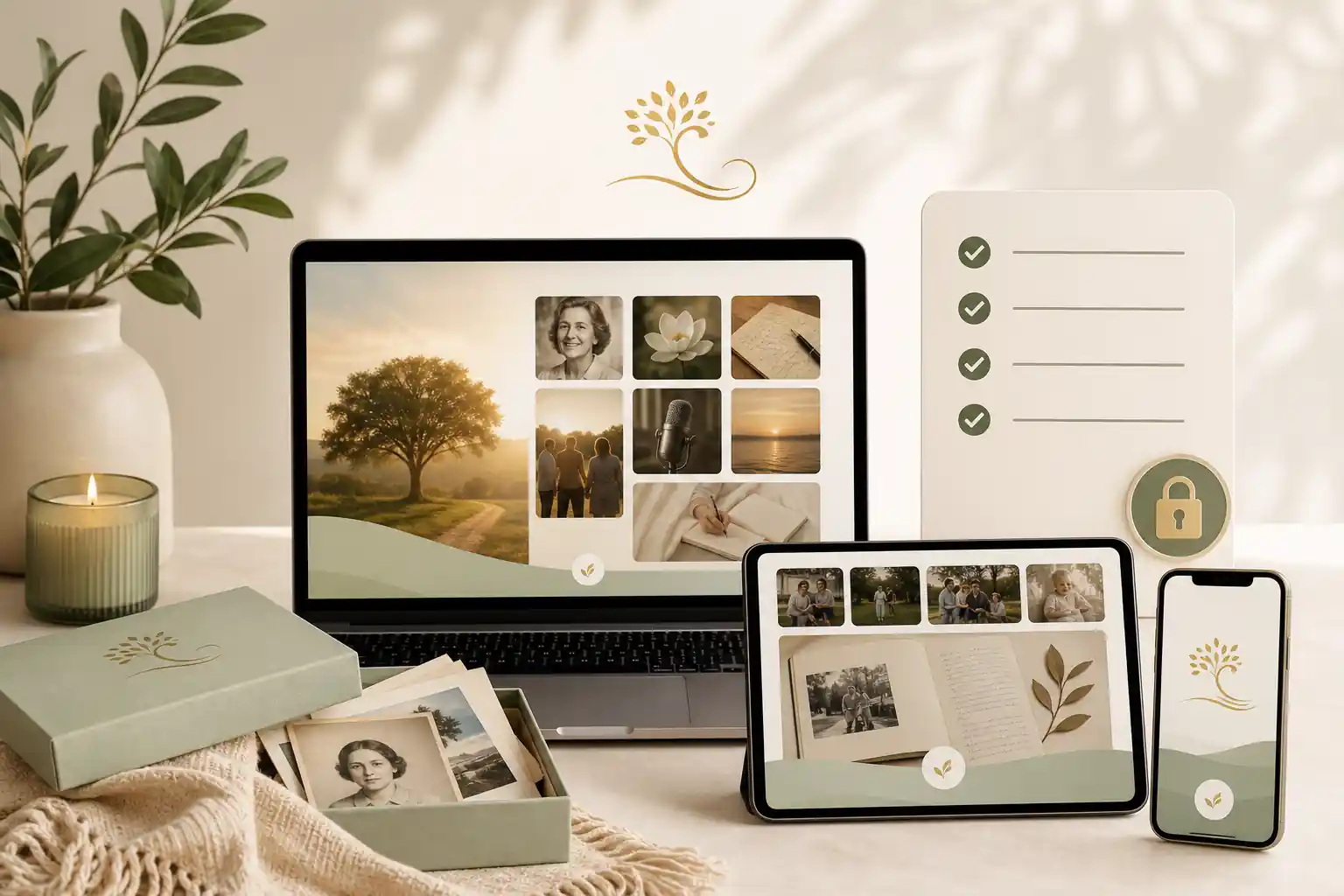
Evaheld Memorials helps families turn scattered memories into an organised memorial experience. Instead of keeping stories in text messages, email threads, phone galleries and loose documents, families can create a memorial page, add photos and messages, gather guestbook contributions, record wishes and keep related information together.
The value is not that one platform replaces every professional or family process. Rather, Evaheld Memorials can sit alongside funeral directors, celebrants, lawyers, counsellors, official records and personal archives as a practical place for remembrance and planning. Families can begin with a simple tribute, then complete sections over time as more memories and details emerge.
For people comparing user friendly online memorials, clean design memorial sites and secure digital remembrance pages, it is worth asking whether the platform supports real family behaviour: gradual updates, shared contributions, privacy decisions and clear navigation. You can create a memorial page and review the available features before deciding what level of detail feels right for your family.
Final checklist
Before choosing between the best online memorial websites or finalising a digital memorial platforms comparison, use this practical checklist:
- Is the platform easy for family members of different ages to use?
- Can you add stories, photos, guestbook messages, wishes and practical notes in one place?
- Are privacy and sharing settings clear?
- Can trusted people contribute without confusion?
- Is the pricing transparent, including any free vs paid online memorials difference?
- Can the page be updated after publication?
- Have you avoided sensitive personal, financial, medical or account details on public pages?
- Are important photos and files labelled with names, dates and context?
- Does at least one trusted person know how the memorial is managed?
- Have jurisdiction-sensitive documents been checked against local rules or reviewed by a qualified professional where needed?
The best platform is the one your family will actually use: secure enough to trust, simple enough to maintain, and thoughtful enough to preserve the person’s story with warmth and accuracy. Evaheld Memorials gives families a practical way to begin, organise memories and share them carefully when the time feels right.
FAQs about platforms for storing life stories
What are the best platforms for storing life stories?
The best platforms for storing life stories are secure, easy to update, simple for family members to contribute to, and clear about privacy, sharing and long-term access. For most families, the strongest choice is a platform that combines photos, stories, audio or video, guestbook messages, wishes and practical instructions in one organised place, rather than scattering memories across phones, social media accounts and cloud folders.
The best platforms for storing life stories are those that combine easy story capture, photo and message storage, privacy controls, family sharing, clear pricing and long-term access. Evaheld Memorials can help families organise memories, wishes and tribute content in one place; you can also review personal digital archiving guidance from the Library of Congress.
How can an online tribute feel personal and respectful?
Platforms for storing life stories are used to keep memories, photos, videos, voice notes, tributes, guestbook messages and important wishes together so family members are not searching through scattered folders or devices later. A memorial page can provide a central place to begin, alongside practical family archive advice from the U.S. National Archives.
When should a family create or review the memorial?
A family might use one before a funeral, after a death, during life story recording, when downsizing family belongings, or when older relatives want to preserve memories for future generations. Evaheld Memorials’ online memorial features support gradual updates, while the Digital Preservation Coalition Handbook explains why ongoing care matters for digital material.
Who should manage the page and approve contributions?
Include key life events, favourite stories, photos, videos, audio messages, cultural or faith details, family reflections, funeral preferences, and any notes that help loved ones understand what mattered most. For structured planning, see Evaheld Memorials’ digital legacy vault, and consider privacy guidance from the Office of the Australian Information Commissioner.
What content belongs on the memorial page?
Start with a short biography, add photos and milestones, invite trusted contributors, review privacy settings, check important details, then update the page over time. You can create secure platforms for storing life stories with Evaheld Memorials, and follow account-safety basics from CISA’s Secure Our World.
How can families control privacy and sharing?
Common mistakes include uploading files without context, forgetting permissions, using weak passwords, leaving out important relatives, and assuming a free option will meet every long-term need. Compare Evaheld Memorials’ online memorial plans with your family’s needs, and review password manager guidance from the Australian Cyber Security Centre.
Which account details and backups should be retained?
Avoid sharing sensitive personal information publicly, publishing private family details without consent, relying on one person’s login only, or treating a memorial platform as a substitute for formal legal advice. Evaheld Memorials’ memorial support questions can help with practical use, while the eSafety Commissioner’s privacy guidance explains online privacy risks.
How can relatives contribute safely?
Privacy and permissions usually determine who can view, contribute to, edit or share the memorial content. Look for clear access controls, contributor options and family review processes. Evaheld Memorials’ feature overview outlines practical sharing tools, and the UK Information Commissioner’s Office explains public-facing privacy rights.
What common online memorial mistakes should families avoid?
Evaheld Memorials helps families create, complete, store, update and share life stories, photos, guestbook messages, tribute pages, wishes and related instructions in an organised memorial experience. You can start with creating a memorial page, while the FTC’s online privacy guidance is useful for safe digital sharing.
How does Evaheld Memorials support long-term preservation?
Before publishing, check names, dates, permissions, image quality, privacy settings, contributor access, spelling, links, and whether any sensitive information should stay private. If comparing formats, read Evaheld Memorials’ guide to the top virtual tribute pages, and review multi-factor authentication advice from the Australian Cyber Security Centre.
If your family is ready to begin, create a free Evaheld Memorials page and add memories, photos and tributes at your own pace.