What is the best pet memorial plaque? Pet tribute ideas, wording and memories
A practical, compassionate guide to choosing a pet memorial plaque, with materials, wording, garden stones, QR tributes, privacy and AU/UK/US rule differences.

The best pet memorial plaque is one that can survive its setting, follow local rules, and hold a few true words about the animal you loved, while leaving room for photos, stories, tribute ideas, wording and memories elsewhere. A pet memorial plaque should be short enough to read at a glance, strong enough for its location, and personal enough that it could not belong to any other pet.
For many families, the right choice is not the biggest plaque or the longest inscription. It is a clear name, dates or years, one honest line, and a connected place for the fuller story. That might mean a garden stone at home, a cemetery-approved marker, a pet memorial plaque with a QR code, or a small indoor keepsake paired with a pet memorial page with photos and stories. Pet memorials can be quiet and practical while still carrying the companionship, routines, favorite places, and small daily memories that made the bond real.
How to choose the best pet memorial plaque
Start with the place. A plaque for a sheltered shelf can be delicate; a plaque for a garden, grave, or outdoor wall needs weather-resistant materials, stable fixing, readable engraving, and a design that will not look out of place after years of rain, heat, frost, soil, cleaning, and sunlight. If the plaque will be placed in a public cemetery, pet cemetery, shared garden, rental property, apartment courtyard, or human cemetery, ask permission before ordering anything permanent.
Australia, the United Kingdom, and the United States all treat pet memorial placement differently. In New South Wales, Cemeteries & Crematoria NSW explains in its interment rights guidance that animal remains may be buried or placed in an interment site from September 1, 2025, but cemetery operators are not required to offer that service and can set their own guidelines for animal type, location, method, fees, and site suitability. The safest approach for Australian families is to ask the cemetery, council, property owner, or pet cremation provider what is allowed before choosing a marker.
In England, GOV.UK guidance on animal burials and groundwater protection says small domestic pets such as a dog or cat may be buried on your own land, such as a back garden, while larger animal burial arrangements and pet cemeteries need more care. The wider GOV.UK rules on animal by-product disposal are a reminder that commercial or non-domestic animal arrangements should not be treated like a simple household pet burial. In the United States, rules are state and cemetery specific. New York State’s pet cremated remains guidance allows participating cemeteries to accept pet cremated remains only under defined conditions, and it makes clear that cemeteries may choose not to offer the service.
Once the place is clear, choose the purpose. A plaque can mark a burial place, identify an urn or ashes area, sit beside a tree or rose, attach to a bench, or become a small threshold ritual by a door or window. Some families want a visible public marker. Others want a private object that only close family will see. Both are valid. If privacy matters, decide whether the plaque should carry only the pet’s name and years, or whether it should point to a fuller digital tribute through the basics of a QR memorial.
Materials: garden stones, metals, ceramics, wood and QR plaques
Materials shape both appearance and durability. Natural stone is often chosen for garden stones because it feels settled and modest. Granite, slate, and other dense stones can work well outdoors, but care still matters. The Natural Stone Institute’s natural stone care guidance recommends understanding the stone type, avoiding harsh acidic products, and using appropriate cleaners; that advice is useful for pet memorial plaques because a cleaning mistake can damage lettering or the stone surface.
Bronze feels traditional and warm, but it changes outdoors. The National Park Service’s outdoor bronze conservation note explains that unprotected outdoor bronze corrodes over time and that aggressive cleaning can remove detail. That does not make bronze unsuitable, but it does mean families should expect patina, ask about protective finishes, and avoid abrasive cleaning. Stainless steel and anodized aluminum can look restrained and modern, while ceramic, glass, and resin may suit indoor or sheltered memorials better than exposed ground.
If the plaque includes a QR code, readability matters as much as beauty. DENSO WAVE’s QR Code explanation is useful because it shows that scannability depends on the structure of the code, not just on printing a square pattern onto a surface. A QR memorial must keep enough contrast between code and background, avoid glare, resist fading, and sit where visitors can scan it without touching fragile stone or stepping into planting. Families comparing finishes can use which materials tend to suit QR memorial plaques best as a practical way to think about weather, readability, and design.
For home gardens, a flat stone, small metal stake, engraved tile, or low-profile plaque often feels more natural than a cemetery-style headstone. Garden stones can sit near a favorite sunny patch, under a tree, by a path, or beside a pot with seasonal planting. Pet memorials do not need to imitate human grave markers; garden stones can be simple, domestic, and deeply personal.
What should a pet memorial plaque say?
Good pet memorial plaque wording usually has three parts: the pet’s name, a date line or life span if known, and one short phrase. Rescue animals, foster pets, and older adopted animals may not have a known birth date. In those cases, use the years they were part of your life, the year they arrived, or just the year they died. Accuracy matters more than symmetry.
Useful wording patterns include name plus years, name plus nickname, name plus role, or name plus a small habit. For example: “Milo, our window watcher”; “Ruby, loved from 2014 to 2026”; “Scout, the best walking companion”; “Bella, always at the gate”; or “Oscar, king of the warm laundry.” These lines work because they say something specific. Generic words can still be comforting, but the best plaque wording often comes from ordinary family language.
If you are unsure what to write, list three things first: what you called them, where they loved to be, and what you will miss in the everyday routine. That may lead to a phrase no template could offer. For deeper wording support, especially when a physical marker and digital remembrance will work together, pet memorial headstone wording with memories and QR tribute planning can help you shape a line that fits the plaque without losing the fuller story.
Space changes wording. Long inscriptions can become cramped, expensive, or hard to read. The stronger approach is to let the plaque hold the core and let the story live elsewhere. A QR-linked memorial can hold the adoption story, silly habits, photos, voice notes, videos, drawings from children, and condolences from people who knew your pet. Evaheld families often pair a physical plaque with the kinds of content a memorial QR code can open so the stone stays calm and the memories stay rich.
Pet tribute ideas beyond the plaque
A plaque is only one part of remembrance. Cornell University College of Veterinary Medicine’s pet loss resources note that grief after the death of a companion animal can be physical, emotional, social, intellectual, and spiritual. That is why practical memorial acts can help. They give grief somewhere gentle to go without forcing anyone to perform or explain it.
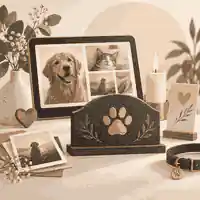
Consider a small memory table with a collar, lead, tag, toy, framed photograph, paw print, or favorite blanket. Plant herbs or flowers near a garden stone. Keep a photo album in the room where they spent the most time. Ask family members to write one short memory on paper before the plaque wording is finalized. If children are involved, invite drawings, but do not pressure them to produce a polished tribute. A simple picture of the pet’s bed, bowl, or favorite tree can be more honest than a formal message.
The American Veterinary Medical Association’s pet loss and grief brochure emphasizes that grief is not ranked and that the bond with a pet deserves care. That matters because some people still minimize pet loss. If a plaque, garden stone, online tribute, or small ritual helps the family acknowledge the reality of the death, it is not excessive. It is a form of mourning.
Shared memories can be especially helpful when a pet belonged to a whole household or became part of a wider community. Neighbors may remember the dog who greeted them at the fence. Friends may have photos from walks, holidays, or pet-sitting. Relatives may remember a cat who always chose one guest’s lap. Letting loved ones contribute can turn a solitary marker into a fuller tribute, especially through letting loved ones leave tributes and condolences.
Surviving animals may also react to the absence. RSPCA Australia’s animal grief guidance describes behavioral changes that can follow the loss of another animal in the household and recommends maintaining routine while seeking veterinary advice if concerning changes appear. This does not mean every pet needs a formal ritual, but it does mean the household may need steadiness as well as remembrance.
Rules, privacy and public placement
Before placing a plaque outside your own property, ask three questions: who owns the land, who controls memorial items, and who maintains the area? In cemeteries, rights holders often have specific authority over memorial installation. In shared gardens, strata, councils, landlords, and cemetery operators may all have rules. Evaheld’s cemetery rules for QR codes advice applies equally to pet memorial plaques: permission should come before purchase, and written approval is better than a verbal yes.
In the United States, the Federal Trade Commission’s Funeral Rule guidance applies to human funeral providers rather than pet memorial retailers, but its pricing lesson is still useful for consumers: ask for clear itemized costs before deciding. Pet plaque orders can involve engraving fees, artwork setup, proof revisions, shipping, installation, cemetery approval fees, replacement policies, and digital hosting terms. In Australia, the ACCC’s consumer guarantees guidance is a useful reminder to check what a supplier promises about acceptable quality, durability, and remedies if the product is faulty.
Privacy is another rule of care. A plaque in a public place can reveal names, dates, addresses, or a QR destination. Do not put sensitive family information, home addresses, full contact details, or children’s identifying details on the marker or the linked memorial. If a QR code opens a tribute, decide whether the page should be public, private, or limited to invited people. Evaheld’s private and public memorial options can help families avoid sharing more than they intended.
How to plan wording with memories
The hardest part of a plaque is often not material or cost. It is the emotional pressure of making final words feel right. A practical method helps. First, write the facts without decoration: name, nickname, years, species if relevant, and relationship to the family. Second, write ten ordinary phrases you actually used around the pet. Third, choose one tone: gentle, funny, grateful, plain, or traditional. Fourth, test the line aloud. If it sounds like something you would say beside the garden stone, it is probably close.
A plaque for a dog might say “Max, still walking with us,” “Daisy, faithful friend and beach shadow,” or “Luna, our bright-eyed girl.” A cat plaque might say “Mabel, queen of the windowsill,” “Jasper, soft paws and loud opinions,” or “Nell, sunbeam seeker.” For birds, rabbits, horses, reptiles, and smaller companions, avoid forcing dog-and-cat language. Use the routines that were true: the perch, stable, hutch, paddock, tank, song, scratch, whistle, or morning greeting.
When wording feels too small for the life, separate the plaque from the tribute. The plaque does not need to carry every story. Evaheld’s memorial tribute writing guidance can help turn memories into a fuller piece for the digital memorial, while the plaque carries the line that visitors see first. This solves the most common engraving problem: trying to make a small object do the work of a whole biography.
What to include on the connected memorial
A connected memorial should complement the plaque, not repeat it word for word. Include the pet’s name, dates or years, a short life story, favorite photos, the adoption or arrival story, personality details, favorite places, and the family rituals that mattered. You might add the story behind the inscription so future visitors understand why the line was chosen. Evaheld’s meaningful online memorial inclusions can help families decide what belongs on the page and what should stay private.
Famous memorials show how one carefully chosen detail can carry a larger life. A public profile for Steve Irwin naturally brings to mind devotion to animals and conservation; a pet plaque can do the same at a family scale by naming the bond rather than listing achievements. Paul O'Grady, widely remembered for warmth toward animals, is another reminder that public legacy often rests in a repeated act of care. A memorial for Betty White also shows how lifelong affection for animals can become part of how people remember a person. For a pet, the equivalent may be one line about the walk, the window, the whistle, or the welcome home.
Common mistakes to avoid
Do not order before checking placement rules. Do not choose a plaque material only because it looks good in a product photo. Do not crowd the inscription with every date, title, nickname, breed, quote, and symbol. Do not use a QR code unless the linked page is stable, editable, and appropriate for public or private viewing. Do not rely on adhesive or fixing methods without asking whether they suit the surface. Do not clean stone or bronze with harsh household products because a quick clean can cause lasting damage.
Also avoid wording that comforts strangers but does not sound like your pet. “Forever in our hearts” is not wrong, but if your family always called the dog “chief sock thief,” a more personal line may age better. The point is not to be clever. The point is to be true.
A practical decision checklist
Choose the location first, then the rules, material, inscription, linked content, and maintenance plan. For a home garden, confirm drainage, future moving plans, and whether the plaque can be lifted if you relocate. For a cemetery or pet cemetery, ask for written rules on size, finish, wording, installation, maintenance, and approval. For a QR pet memorial plaque, test the code on multiple phones before installation, keep the linked content editable, and make sure someone trusted can manage the memorial over time.
If several family members are involved, agree on the inscription owner. Invite suggestions, but appoint one person to finalize the text after reviewing spelling, dates, and tone. Keep a copy of the final proof. Photograph the installed plaque. Save digital photos, tribute text, and invoices in a shared folder. If grief feels raw, choose a temporary marker first and order the permanent plaque later. There is no rule that the final memorial must be decided immediately.
A pet memorial plaque works best when it is both modest and complete: modest on the surface, complete in the way it connects to memory. When you are ready to turn the plaque into a lasting tribute with photos, stories, and family contributions, Evaheld Memorials can help you begin a pet memorial plaque plan that keeps the physical marker simple and the memories close.


FAQs
What is the best pet memorial plaque? Pet tribute ideas, wording and memories
The best plaque is durable, approved for its location, and written in words that sound true to your pet; a pet memorial page with photos and stories can hold the memories that will not fit on the marker, while Cornell’s pet loss resources explain why remembrance can be part of healthy grieving.
What should I write on a pet memorial plaque?
Use the pet’s name, years if known, and one specific line about their place in your life; pet memorial headstone wording with memories and QR tribute planning can help keep the inscription short, and the AVMA’s pet loss and grief brochure affirms that the bond with a pet deserves care.
Are garden stones good pet memorials?
Garden stones can be excellent pet memorials when they suit the soil, drainage, and household plans; which materials tend to suit QR memorial plaques best is useful for outdoor choices, and the Natural Stone Institute’s natural stone care guidance explains why mild, stone-safe cleaning matters.
Can I put a pet plaque in a cemetery?
Sometimes, but permission depends on the cemetery, grave type, rights holder, and local rules; cemetery rules for QR codes gives a practical approval mindset, and Cemeteries & Crematoria NSW’s interment rights guidance shows how animal remains and memorial decisions can be locally controlled.
Can I bury a pet at home in the UK?
In England, small domestic pets may usually be buried on your own land, but families should still consider water, future land use, and local conditions; private and public memorial options can help decide how visible the tribute should be, and GOV.UK’s animal burial guidance explains the groundwater context.
Can pets and people be memorialized together in the United States?
It depends on state law and cemetery rules, so ask the cemetery before assuming pet ashes or wording can be included; the basics of a QR memorial can offer a shared digital alternative, and New York State’s pet cremated remains guidance shows how specific the rules can be.
Should a pet memorial plaque include a QR code?
A QR code is useful when you want the plaque to stay simple while the linked tribute holds photos, stories, and updates; the kinds of content a memorial QR code can open can help plan the page, and DENSO WAVE’s QR Code explanation reinforces why readability and contrast matter.
How do I involve children in a pet memorial?
Invite children to draw, choose a photo, share a memory, or help select one gentle line without making them responsible for the final decision; letting loved ones leave tributes and condolences can include their voice, and RSPCA Australia’s animal grief guidance is also helpful when surviving pets are affected.
How should I clean a bronze pet memorial plaque?
Use the supplier’s instructions and avoid abrasive cleaning, especially if the plaque has a patina or protective finish; memorial tribute writing can preserve the story if the surface changes over time, and the National Park Service’s outdoor bronze conservation note warns that aggressive treatments can damage detail.
What should I check before buying a pet memorial plaque online?
Check material, size, proofing, engraving limits, delivery, warranty, replacement policy, QR hosting terms, and installation rules; meaningful online memorial inclusions can help you plan the linked tribute, and the ACCC’s consumer guarantees guidance explains why clear product promises matter.