What questions should I ask grandparents for family history? Prompts, photos and legacy preservation
A practical guide to family history questions for grandparents, including prompts, photos, recording, privacy, verification and legacy preservation.
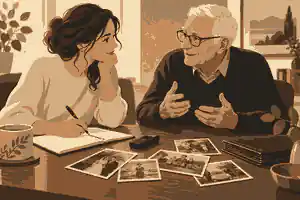
What questions should I ask grandparents for family history? Prompts, photos and legacy preservation should begin with open questions about childhood, parents, grandparents, homes, migration, work, love, traditions, hard seasons, treasured objects, photographs and the values they want future generations to understand. The best interview does not try to force a complete life history in one sitting; it helps a grandparent tell specific stories in their own words, then preserves those stories with consent, context and care.
If you are wondering what questions should i ask grandparents for family history, start with the questions that only they can answer: what ordinary days felt like, who shaped them, why the family moved, what old photographs show, which stories are uncertain, and what they hope the family remembers. Evaheld Memorials families often pair these conversations with family history preservation prompts so the interview becomes organised family stories, photos and life history rather than a folder of disconnected notes.
what questions should i ask grandparents for family history: practical guidance
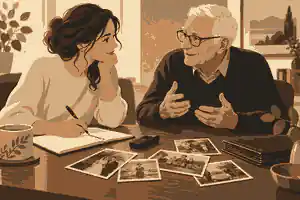
A family history interview is personal. Before asking anything sensitive, explain what you are doing, ask whether recording is acceptable, and say who may see the recording, transcript or written notes. The Smithsonian oral history guidance is clear that planned recorded interviews work best when the narrator understands the purpose, their rights and how the material will be handled. That same respect matters at a kitchen table.
Choose a quiet room, keep the first session short and bring water, photographs, names, dates and a loose outline. Do not begin with the hardest question. Begin with a memory that has texture: a childhood bedroom, Sunday lunch, a favourite teacher, the walk to school, the smell of a workshop, the sound of a language spoken at home. If a grandparent is tired, unwell or living with memory changes, slow down. The Alzheimer's Society communication advice supports calm, patient conversation, one point at a time, without rushing the person.
Recording is valuable because tone, pauses, laughter and uncertainty can be as meaningful as facts. If recording feels too formal, take handwritten notes and photograph the notes immediately afterwards. Families who want a broader life-story project can use record your life story before its lost forever to plan audio, video, prompts, consent and digital preservation.
Core questions to ask grandparents about family history
The strongest questions are open, specific and gentle. Instead of asking, 'Tell me everything about your childhood', ask, 'What was your kitchen like when you were young?' or 'Who usually sat where at the table?' These questions help memory attach to place, object and routine.
Use these prompts as a menu, not a script. Ask fewer questions and listen more deeply.
- What is your full name, and were you named after anyone?
- Where and when were you born, and what do you remember about that place?
- Who lived in your home when you were a child?
- What were your parents or caregivers like when no guests were around?
- What do you remember about your grandparents or older relatives?
- What languages, sayings, songs or prayers did you hear at home?
- What did a normal school day look like?
- Who were your closest friends, cousins or neighbours?
- What games, toys, chores or work filled your childhood?
- What meals, recipes or food traditions belonged to your family?
- Did the family ever move, migrate or separate, and why?
- What work did people in the family do, paid or unpaid?
- What events in the wider world changed family life?
- What did you believe about the future when you were young?
- Which family stories were repeated often, and which were rarely discussed?
- What object, document or photograph would you most want preserved?
- What should younger relatives understand about where our family comes from?
For Australian families, the National Library of Australia family history research guide shows why oral memories become stronger when paired with newspapers, photographs, maps, manuscripts and other records. For US families, the US National Archives genealogy starting points are useful once names, places and dates begin to emerge. In England and Wales, official civil registration began in July 1837, and the GOV.UK General Register Office family history guidance explains how birth, adoption, marriage, civil partnership and death certificates can support later research.
Questions that bring photographs and objects to life
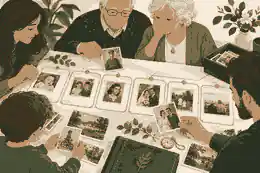
Old photographs often hold the fastest route into family memory. Put one image on the table and ask the grandparent to describe it before you identify anyone. What season was it? Who took the picture? What happened just before or after? Who is missing? What was the relationship between the people in the photograph? If the answer is uncertain, record that uncertainty honestly.
Try these photo prompts:
- Who is in this photograph, and how were they related?
- Where was it taken, and what was that place like then?
- What do you remember about the clothes, house, car, garden or street?
- Who might know more about this image?
- Is there anyone pictured whose story has been misunderstood?
- Should this photo be public, family-only or private?
The Library of Congress photograph care advice recommends careful handling and storage because photographs are vulnerable to heat, moisture, light and poor materials. Scan or photograph originals, but keep the original context: envelopes, handwriting, album order and the person who identified the image. Families preserving images online can use creating an online memorial site with photos and stories to connect visual material with remembered context.
Objects can work the same way. Ask about jewellery, tools, medals, recipes, letters, books, furniture, clothing, musical instruments, sporting trophies and religious items. A plain item may hold a migration story, a wartime memory, a family business, a courtship, a loss or a promise. When the story is sensitive, label it carefully and decide whether it belongs in a private family archive rather than a public memorial.
Questions about relationships, love and family roles
Family history is not only lineage. It is also how people cared, argued, reconciled, worked and made decisions. Ask about friendships, courtship, marriage, separation, parenting, aunties, uncles, neighbours, mentors and people treated as family even when they were not relatives by blood.
Useful prompts include: How did you meet your partner or closest friend? Who helped raise you? Who did the emotional work in the family? Who kept everyone connected? What family rule was spoken, and what rule was understood without being said? Were there relatives who were especially kind, difficult, private or influential? What did people do when money was tight, illness came, or someone needed help?
For public records, family memory needs checking. The US National Archives census guidance explains how census schedules from 1790 to 1950 can support family research, while the UK National Archives census records guide helps families understand what census records may show in England, Wales and Scotland. Northern Ireland searches may use GRONI, and nidirect GRONI online records guidance explains free name searches, paid credits and civil registration search details. Use records to support, not replace, a grandparent's lived account.
Questions about migration, place and belonging
Migration stories often sit at the centre of family history. Ask what the family called the old country, town, station, suburb, village or homeland. Ask who left first, who followed, what was packed, what was lost, what language changed, what food stayed, what name changed and what people missed.
These questions help: What was the first home you remember clearly? Did our family move for work, safety, marriage, study, war, land, money or opportunity? Were there letters from relatives elsewhere? Was there a place people talked about but never returned to? What did people keep from the old place? What customs survived after the move?
For Australian, United Kingdom and United States readers, place names need special care because a single family may have lived under changing borders, counties, colonies, states, territories, parishes or registration districts. Write down the name your grandparent uses first, then add the modern official place name if it is different. Ask about nearby landmarks, schools, churches, cemeteries, railway stations, farms, streets and neighbours, because these clues often solve record problems when spellings have shifted. If a family story crosses countries, record each stage separately: the place left, the journey, the first address on arrival, the sponsor or relative who helped, and the moment the family began to feel settled.
For Aboriginal and Torres Strait Islander, First Nations, Indigenous, adoptee, child migrant, institutional care, refugee or separated-family histories, proceed with extra care. Some records may contain distressing language or may have been created by authorities that harmed the family. Ask who has the cultural or family authority to share a story, what should remain restricted, and whether a public memorial is appropriate.
Questions about values, faith, work and hard seasons
Grandparents often carry not only facts but interpretation. Ask what they learned from hardship without demanding painful detail. If they want to talk, listen; if they do not, leave the door open. Respect is more important than completeness.
Good prompts include: What are you proud of surviving? What work shaped you most? Did faith, religion, culture or philosophy guide the family? What did people do when someone died? What was considered respectful at funerals or memorial gatherings? What changed after war, recession, illness, migration, divorce or bereavement? What advice did you ignore? What advice do you still believe?
When the interview becomes emotional, pause. Ask whether they would like to stop, change topic or continue another day. A family history project should not turn a grandparent into a source to be mined. It should honour the person as a living participant with boundaries.
How to preserve answers accurately
After the interview, write a short summary while memory is fresh. Include the date, place, interviewer, grandparent's full name, recording filename, topics discussed, names mentioned, photographs shown, permissions given and follow-up questions. If you have audio or video, transcripts help future relatives search and understand the recording; the W3C transcript guidance explains why transcripts improve access to recorded media.
Use clear labels: confirmed by record, remembered by interviewee, family tradition, uncertain, sensitive, private. This protects accuracy and avoids turning a tentative memory into a false fact. The strongest family archive lets future relatives see the difference between evidence and recollection.
Digital preservation needs more than uploading. Use meaningful filenames, keep originals, export copies, and store material in at least two places. digital memories and social media guidance can help families think about photos, posts, videos and accounts, while meaningful online memorial inclusions helps decide which selected stories belong in a memorial rather than a private archive.
A simple file structure helps future relatives trust what they find. Keep one folder for original recordings, one for transcripts, one for photographs, one for permissions, and one for edited family stories. Do not rename original files after sharing them widely unless you keep a stable cross-reference. Add a short note explaining who created the archive, which devices or apps were used, what remains unverified and who should be contacted before any public use. These small administrative choices make family stories easier to protect after the first organiser is no longer available.
How to turn answers into a legacy without losing privacy
A finished legacy may be a transcript, printed booklet, captioned photo album, family tree, audio recording, private archive, memorial page or a mixture of all of these. The format matters less than clarity, consent and future access. Decide what is public, what is family-only, and what should remain private for now.
When a grandparent has died, their stories can help a memorial feel specific rather than generic. A profile for Maya Angelou is a reminder that a life can be remembered through voice, work, family names and story; her official biography at the Maya Angelou Caged Bird Legacy site also shows how a public life is anchored by dates, places and creative work. A public profile for Queen Elizabeth II illustrates how family, duty and Commonwealth memory can sit beside public chronology, and the Royal Family account of Queen Elizabeth II's life and reign provides authoritative context for those public facts. A profile for Steve Irwin shows how place, vocation and family identity can become part of lasting remembrance.
For ordinary families, the same principles apply on a smaller scale: choose stories that are accurate, kind and meaningful. Before inviting relatives to add memories, gather the basics using what information you need to start a memorial. Then decide whether close relatives should contribute through trusted contributor access, and whether the memorial should stay private until the family is ready.
A practical interview sequence for one hour
For a first session, keep the structure simple. Spend five minutes confirming permission, comfort and recording. Spend ten minutes on basic facts: full name, birth details, parents, siblings and places. Spend fifteen minutes on childhood and household life. Spend ten minutes on photographs or objects. Spend ten minutes on a chosen theme such as migration, work, love, faith or family traditions. Spend five minutes asking what they want younger relatives to remember. Spend the final five minutes checking names, spellings and whether any part should remain private.
Avoid correcting constantly during the interview. If a date sounds wrong, make a note and verify later. If two relatives remember the same event differently, preserve both versions with attribution. Oral history is valuable because it records perspective, not because every sentence is a perfect legal record.
When the interview is ready to become a written tribute, life story obituary prompts can help turn raw answers into a respectful narrative. If the family has voice clips, home movies or songs, video and music memorial options can support a richer tribute while keeping consent and tone in view.
Common mistakes to avoid
Do not ask only dates and names. Do not interrupt silence too quickly. Do not publish living people's private information without consent. Do not treat painful topics as content. Do not assume one grandparent speaks for the whole family. Do not crop old photographs without keeping originals. Do not label uncertain memories as fact. Do not wait for the perfect equipment before beginning.
Also avoid making the project so large that no one finishes it. A single recorded conversation, ten labelled photographs and one carefully written summary are better than an ambitious archive that never leaves your notes. Family history preservation is cumulative; it grows because one respectful step makes the next step easier.
If your family is ready to turn interview answers, photo captions and remembered details into a lasting shared space, Evaheld Memorials can help you begin with what questions should i ask grandparents for family history as the organising theme, then add stories and photographs at a pace that suits the family.
FAQs
What questions should I ask grandparents for family history? Prompts, photos and legacy preservation
Ask about childhood homes, parents, grandparents, migration, work, school, traditions, love, hard seasons, photographs, keepsakes and the values they want remembered. Keep the session conversational, record with permission, and preserve answers with context; family history preservation prompts can help organise the next step, while the Smithsonian oral history guidance explains why preparation, consent and open questions matter.
How many questions should I ask in one interview?
For a first session, choose 10 to 15 strong prompts and allow follow-up questions, pauses and stories that were not on your list. A shorter, kinder recording is usually more useful than an exhausting session; record your life story before its lost forever supports that paced approach, and the Alzheimer's Society communication advice is helpful when memory or fatigue is a concern.
Should I record my grandparent on audio or video?
Audio is often less intrusive, while video can preserve expression, gestures and objects shown during the conversation. Ask permission, test the equipment, and save backup copies; digital memories and social media guidance can help with preservation planning, and the W3C transcript guidance explains why transcripts make recordings easier to use later.
What should I ask about old family photos?
Ask who is pictured, where the photograph was taken, who took it, what happened around that moment, who is missing, and whether the image should be public, family-only or private. Keep original context wherever possible; creating an online memorial site with photos and stories can connect captions with remembrance, and the Library of Congress photograph care advice explains basic handling and storage.
How do I verify family stories after the interview?
Label answers as remembered, confirmed, uncertain or private, then compare names, dates and places with certificates, census records, newspapers and local archives. what information you need to start a memorial overlaps with the details you will verify, and the US National Archives genealogy starting points are useful for American records.
What if my grandparent does not want to talk about the past?
Respect the boundary and offer lighter alternatives, such as identifying photographs, explaining recipes, naming relatives or choosing music. A family history project should never pressure someone into painful disclosure; stay private until the family is ready reflects the same privacy principle, and the Smithsonian oral history guidance notes that narrators should be able to choose what they answer.
Which family history questions help with UK records?
Ask for full names, maiden names, dates, districts, parishes, addresses, occupations, marriages, siblings and places of burial, because these details help families search civil registration, parish and census records. life story obituary prompts can organise those details into a narrative, while the GOV.UK General Register Office family history guidance explains birth, marriage and death certificate research in England and Wales.
Which questions are most useful for Australian family history?
Ask about migration, state or territory, Country, suburb, station, school, military service, newspapers, nicknames, photographs, community groups and where records or keepsakes may be stored. family history preservation prompts help turn those answers into an archive, and the National Library of Australia family history research guide explains the breadth of Australian sources.
How can relatives contribute after the first interview?
Share a summary, invite specific corrections, ask for photographs with captions, and give people a clear way to add memories without overwriting the original interview. trusted contributor access can support careful collaboration, and the US National Archives census guidance shows how additional relatives can help verify household details.
How do I turn grandparent interview answers into a memorial tribute?
Choose the most accurate, kind and specific stories, keep sensitive material private, add photographs with captions, and preserve the original recording or notes alongside the edited tribute. meaningful online memorial inclusions can help decide what belongs on the page, while the Royal Family account of Queen Elizabeth II's life and reign shows how public remembrance combines chronology, service, family and context.